


-
Principles of Fusion Power
-
Fusion Device Types
-
Issues in Fusion Power Development
-
World Development in Fusion Power
-
Fusion Power Development in China
-
Useful Links
The ultimate promise of fusion is a carbon-free, environmentally benign and inexhaustible energy supply for the future of mankind.
Principles of Fusion Power
Fusion reactions power the stars, including our Sun. It is this source of energy that sustains lives on earth.
Conversion of Mass to Energy (Fusion & Fission)
Nuclear reactions set free the binding energy that holds the nucleus together. In the process, mass is converted to energy according to Einstein’s famous equation, E = mc2 (where E=energy, m=mass and c=speed of light). A substantial amount of energy can be released from the annihilation of a small amount of mass. Energy can be released from fission (splitting) of heavy nuclei or fusion (union) of light nuclei.
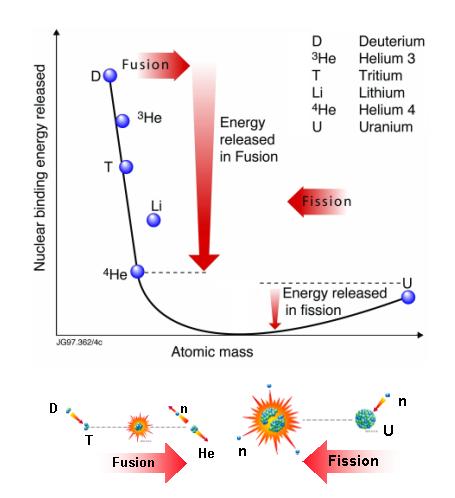
Source: http://www.iter.org/pics/binding.jpg
Fusion Powers the Life on Earth
Fusion is a reaction whereby two atoms join or fuse together to form one new atom. This reaction can produce a large amount of energy, which incidentally is the energy source of the Sun and the stars. For instance, fusion reactions power the Sun by converting hydrogen into helium. In doing so, fusion converts per second 600 million tons of hydrogen into 596 million tons of helium, producing a total power of 3.6×10 GW. Sun ‘cools’ itself by releasing the energy in all directions via radiation of light and the power flux falling on earth is 1.4 kW/m (above the atmosphere, without absorption). Fusion energy, through solar radiation, has sustained the water cycle, wind and life for billions of years; it is the origin of the key renewable energy on earth.
Fuel for Fusion
Fusion reactions involve different nuclei have different reaction rate. Among all reactions the fusion of deuterium (D) and tritium (T), i.e. D-T fusion, converting these two hydrogen isotopes into helium and neutrons, is the easiest to achieve and has been chosen for future fusion power plants.
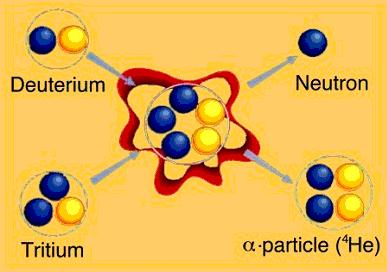
Source: http://www.iter.org/pics/DTreaction.tiff
Advantages of Fusion Power
The ultimate promise of fusion is a carbon-free, environmentally benign and inexhaustible energy supply for the future of mankind. The key advantages are:
- The basic fuels (isotopes of hydrogen) are abundant and distributed widely around the globe. Deuterium, sufficient for billions of years of power supply, can be extracted easily from sea water. Lithium, from which tritium can be produced, is a readily available light metal in the Earth´s crust sufficient for at least 30,000 years of supply.
- There is no need to process the fuel before hand, the gases are easily separated.
- Fusion produces no greenhouse gases or other gases that have damaging effects on the environment. The fuel and the direct-end products (“ashes”) are neither toxic nor radioactive. Only metal parts close to the fusion plasma will become radioactive. Any radioactive waste generated will be small in volume and the radioactivity will decay over several decades with the possibility of reuse after about 100 years. There is no long-term burden on future generations
- The fusion reaction is inherently safe. The amount of fuel present in the fusion reaction chamber is so small that a large uncontrolled release of energy would be impossible.
Requirements for Fusion Reactors
- High Temperature Plasma
When two atomic nuclei are forced into close proximity, nuclear attraction force overcomes the electrostatic repellent force (Coulomb force), and the two nuclei fuse into one nucleus thereby releases fusion energy. Nuclei normally repel one another because of the electrostatic repulsion arising from the charges they carry. In order to fuse, these nuclei have to be given sufficient kinetic energy (i.e. velocity) to overcome their mutual repulsion when they collide. This can only be achieved by heating the D-T fuel to very high temperatures in the range of 100 –150 million degrees centigrade.
The difficulty in producing fusion energy has been to develop a device which can heat the deuterium-tritium fuel to a sufficiently high temperature and then confine it for a long enough time so that more energy is released through fusion reactions than is used for heating. At such temperatures the gaseous fuel is completely ionized, forming a “plasma” comprising of a hot mixture of clouds of positive ions and negative electrons, but is overall electrically neutral. The plasma must not be allowed to come into contact with the walls of the reaction container (vessel), since some of the surface layer of the wall would evaporate and the plasma would be immediately polluted and cooled, losing the conditions for fusion reactions to occur. - Confinement
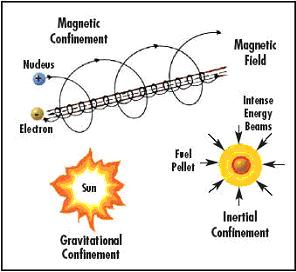
In Star and Sun, gravitational force creates the necessary conditions for fusion to occur. The more practical approaches on earth are magnetic confinement, where a strong magnetic field holds the ionized atoms together while they are heated by microwaves or other energy sources, and inertial confinement, where a tiny pellet of frozen hydrogen is compressed and heated by intense radiation, such as a laser beam, so quickly that fusion occurs before the atoms can fly apart. In other words, magnetic fusion is like a continuously burning nuclear furnace whereas laser fusion is more like an internal combustion engine where the energy is delivered in bursts.
- Breakeven & Ignition (Lawson Criteria)
The fuel plasma needs to reach a high enough temperature to be ‘ignited’. In addition, three parameters (plasma temperature, density and confinement time) need to be simultaneously achieved for sustained fusion to occur. The product of these is called the fusion (or triple) product and the corresponding threshold for D-T fusion to occur is called Lawson Criterion. Attaining conditions to satisfy the Lawson criterion ensures the plasma exceeds ‘breakeven’, i.e., the point where the fusion power released exceeds the power required to heat and sustain the plasma. Substantial progress in magnetic confinement has been made. Near “breakeven” state has been achieved as shown in the diagram below.

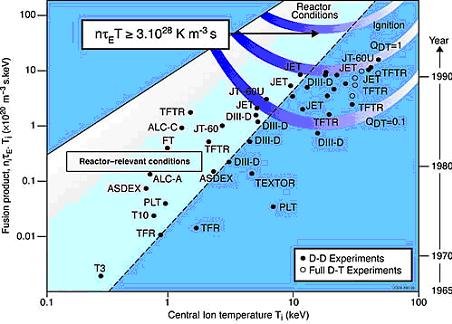
Source: http://www.jet.efda.org/pages/multimedia/yop/dec05-jg04-480-2c.jpg

Many different schemes to realized controlled fusion have been investigated. So far, magnet and inertia confinement schemes appear to be the most promising ones. Within each of the confinement schemes, there are also difference types of fusion confinement configurations (i.e., device types).
Magnetic Confinement
i) Confinement
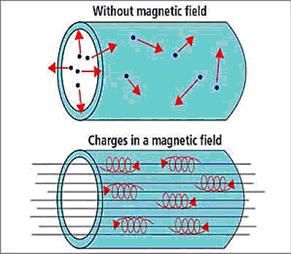
Because of the electric charges carried by electrons and ions (the ionized fuel), a plasma can be confined by a magnetic field. In the absence of a magnetic field, the charged particles move in straight lines and random directions. With no restrictions to their motion, the charged particles can strike the walls of a containing vessel, thereby cooling the plasma and inhibiting fusion reactions. The presence of a magnetic field forces the particles spiral around the field lines. Consequently, the charged particles are confined by the magnetic field and prevented from striking the vessel walls as depicted in the diagramme below. The particles, however, can move freely along the magnetic field lines.
Source: http://www.jet.efda.org/images/fusion-basics/magconfinement-s.jpg

There are two principal magnetic configurations to stop the end losses:
- Open Trap - the magnetic field lines enter and leave the region where the plasma resides. Such a field would hinder ions and electrons from being lost radially, but not along the field lines. A magnetic mirror geometry is incorporated to stop the end losses.
- Close Trap – the plasma occupies a toroidal magnetic field geometry. In this configuration, the field lines bend around to close on themselves thereby eliminate the losses. A simple toroidal field, however, provides poor confinement because the radial gradient of the field strength results in a plasma drift radially out of the torus.
In the early days, a number of different confinement configurations were tried out. Initial investigations were on linear devices, but loss of particles from the ends of these machines quickly led to experiments which wrapped the field round to form a torus. The field variation of a simple toroidal field results in a plasma drift and hence losses. The situation is improved with a helical field configuration and one of the most successful configurations is the ‘tokamak’.
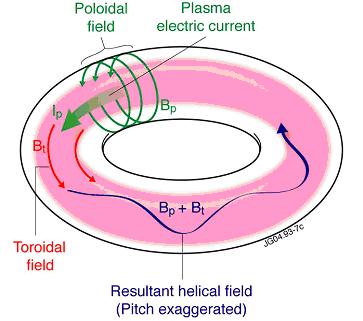
In a tokamak, the plasma is driven to carry a current circulating the toroidal chamber. This plasma current provides a component of poloidal field in the plasma in addition to the externally applied toroidal field. The resultant fields spiral round to form a helical field configuration. Particles orbiting the field line are constrained near this surface, unless they collide with other particles. There are also "poloidal field coils" that generate a vertical field which interact with the plasma current to produce a radially inwards force on the plasma ring. The poloidal field coils are used to add beneficial shaping to the plasma minor cross section (stretching it vertically), and to generate channels for particle and energy exhaust.
Source: www.tpg.efda.org/hcd/index.htm
Research on magnetic confinement has further been conducted on a number of other configurations, such as the stellarator, where the magnetic field is almost entirely generated by external current sources, and the reversed field pinch where a larger portion of the magnetic field is due to the plasma currents than that in a tokamak.
ii) Heating
In an operating fusion reactor, part of the energy generated will serve to maintain the plasma temperature as fresh deuterium and tritium are introduced. However, in the startup of a reactor, either initially or after a temporary shutdown, the plasma will have to be heated to the ignition temperature. There are a number of heating schemes:
- Ohmic Heating
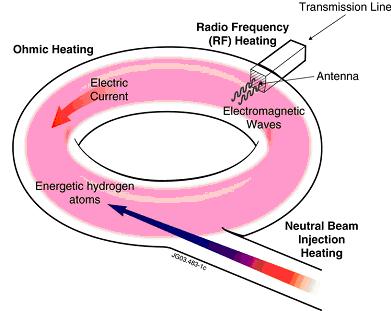
Since the plasma is an electrical conductor, it is possible to heat the plasma by passing a current through it; in fact, the current that generates the poloidal field also heats the plasma. The heat generated depends on the resistance of the plasma and the current. But as the temperature of heated plasma rises, the resistance decreases and the ohmic heating becomes less effective. To reach the ignition temperature, additional heating methods is needed. - Neutral-Beam Injection
Neutral-beam injection involves the introduction of high-energy (neutral) atoms into the ohmically -- heated, magnetically -- confined plasma. The atoms are immediately ionized and are trapped by the magnetic field. The high-energy ions then transfer part of their energy to the plasma particles in repeated collisions, thus increasing the plasma temperature. - Radio-frequency Heating
In radio-frequency heating, high-frequency waves are generated by oscillators outside the torus. If the waves have a particular frequency (or wavelength), their energy can be transferred to the charged particles in the plasma, which in turn collide with other plasma particles, thus increasing the temperature of the bulk plasma.
Source: www.tpg.efda.org/hcd/index.htm
iii) Magnetic Fusion Power Plant
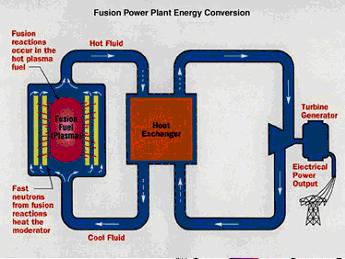
A fusion power plant would be like a conventional one, but heat energy coming from a fusion reactor running on fusion fuel (a deuterium-tritium (D-T) mixture).
The fuel, in the form of very high temperature plasma, is held away from the chamber walls by magnetic forces long enough for a useful number of reactions to take place. The generated energy is re-circulated within the plasma via collisions of the charged fusion products (helium nuclei) with the newly injected cold fuel atoms which are then ionized and heated to sustain the fusion reaction. The neutrons, having no charge, move in straight lines through the thin walls of the vacuum chamber with little loss of energy.
The neutrons and their 14 MeV of energy are absorbed in a "blanket" containing lithium which surrounds the fusion chamber. Through collisions with the lithium nuclei, the neutrons slow down and give up their kinetic energy to heat up the blanket. The heat is extracted through a cooling circuit and conveyed to a conventional steam electric plant. The neutrons themselves ultimately react with lithium to generate tritium which is separated and fed back into the reactor as a fuel.
Specific engineering requirements of a fusion power plant include use of materials resistant to energetic neutron bombardment, thermal stress, and magnetic forces, and design of exhaust systems for the removal of spent gas.
Source: http://www.pppl.gov/fusionpowerplant.cfm
Inertia Confinement
i) Compression and Ignition
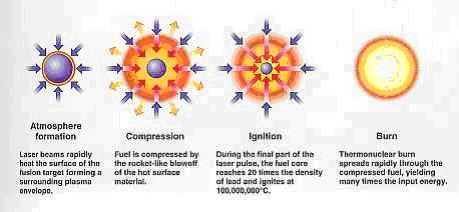
Inertia confinement involves the use of very high power beams (particle or laser) to compress and heat the fuel pellet to the point of fusion. The rapid heating caused the outer layer of the target to explode outward, producing a reaction force against the remainder of the target, accelerating it inwards in a rocket-like implosion. The implosion causes compression of the fuel inside the capsule and formation of a shock wave, which further heats the fuel in the very center and results in a self-sustaining burn known as ignition. The fusion burn propagates outward through the cooler, outer regions of the capsule much more rapidly than the capsule can expand. In essence, the plasma is confined by the inertia of its own mass.
Source: http://www.iter.org/a/index_nav_2.htm
Typical fuel pellets are about the size of a pinhead and contain around 10 milligrams of fuel: in practice, only a small proportion of this fuel will undergo fusion, but if all this fuel were consumed it would release the energy equivalent to burning a barrel of oil.
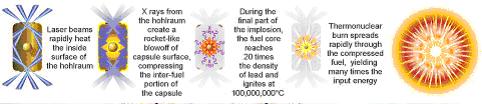
The beams can be applied directly (the “direct drive” mode) onto the target pellet. Alternatively in the ‘indirect drive’ mode, the beams can be used to heat the inner walls of a gold cavity called a hohlraum containing the pellet, creating a superhot plasma which radiates a uniform "bath" of soft X-rays. The X-rays rapidly heat the outer surface of the fuel pellet, causing a high-speed ablation, or "blowoff," of the surface material and imploding the fuel capsule in the same way as if it had been hit with the beams directly.
Source: https://lasers.llnl.gov/programs/nic/icf/how_icf_works.php
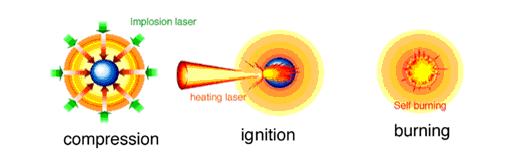
In the “fast-ignition” approach, the pellet is firstly compressed to a density hundreds or thousands times of the density of solid materials, then a short (one billionths of a second), ultra-intense (~1015 Watts) laser pulse is injected to further heat and ignite the ultra-high density plasma. This approach allows separate optimization of the high-density implosion and the heating process to achieve a greater efficiency and yield of fusion reactions.
Source: http://www.ile.osaka-u.ac.jp/zone3/explanation/what/index_e.html
ii)Inertia Fusion Power Plant
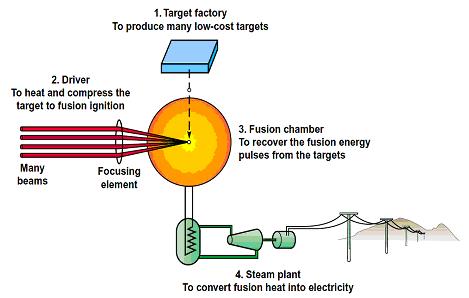
A fusion power plant is expected to be similar to a conventional one, but with heat energy coming from a fusion reactor. In an IFE power plant, many (typically 5-10) pulses of fusion energy per second would heat a low-activation coolant, such as lithium-bearing liquid metals or molten salts, surrounding the fusion targets. The coolant in turn would transfer the fusion heat to a power conversion system to produce electricity as in a conventional power plant.
Source: https://lasers.llnl.gov/programs/ife/how_ife_works.php
An inertia fusion reactor would have three major facilities:
- A target fabrication plant, target injection and tracking systems - The target factory must produce a continuous supply of high-quality targets at an acceptable cost. Typically, the deuterium-tritium (D-T) fusion fuel is contained in a spherical fuel capsule made of suitable materials such as beryllium, carbon or carbon-hydrogen polymers. The fuel capsule must be cold enough for D-T to freeze and form a layer of D-T ice on the inner wall of the capsule. The target injection and tracking systems injects the targets to the ideal fixed position with beams well aligned to assure the precise illumination required to achieve ignition and high energy gain. For an inertia fusion reactor, the targets will have to be injected at speeds greater than 100 meters a second.
- Driver – Drivers are likely to be high power lasers operating at a repetition rate of five to ten shots a second.
- A target chamber and heat recovery plant - Each fusion target releases a burst of fusion energy in the form of high-energy (14-million-electron-volt) neutrons (about 70 percent of the energy), X-rays and energetic ions. The fusion chamber must contain this blast of energy and convert the sequences of energy pulses into a steady flow of power for the power conversion system. The chamber design must include a 50- to 100-centimeter-thick region that contains lithium (as a liquid metal, molten salt or solid compound) in order to produce tritium through nuclear reactions with the fusion neutrons. This region is called the breeding blanket and must produce at least one tritium atom for every tritium atom burned in the fusion target – a tritium breeding ratio equal to or greater than one.
Fusion power is environmentally benign since it would contribute nothing to the greenhouse effect or to pollution of the atmosphere by acidic emissions.
Because fusion’s safety is based on inherent and passive features, it will be readily demonstrable to the non-scientist. Thus fusion is not expected to suffer from problems of public acceptance.
However, it is not yet certain that fusion’s potential can be realised in an acceptably economic form. Determining whether this can be done is the purpose of the world-wide fusion research and development programme. Present indications are that the cost of fusion electricity will be comparable to the cost of fossil-fuel and fission electricity.
The ultimate objective of the fusion research and development program is to bring one or more fusion reactor concepts to the stage at which that concept is sufficiently demonstrated that the energy industry is willing to construct a fusion power station. The fusion development programme needs to demonstrate:
- the reliable, controlled operation of a D-T fusion plasma under reactor-relevant conditions;
- the reliable operation to some significant fraction of their anticipated lifetime of reactor-extrapolatable technologies, components and systems under fusion reactor conditions;
- the reliable operation of an integrated fusion reactor at availabilities that are extrapolatable to commercial requirements;
- tritium fuel self-sufficiency;
- net electrical power production at significant levels (> 100s of MW);
- the safety of fusion reactors;
- the feasibility of economically competitive fusion reactors; and
- the feasibility of environmentally benign fusion reactors.
Progress
The research into harnessing fusion energy for power generation began in the late fifties. The scientists at the time thought that fusion power would be developed within some tens of years. However, the highly complex and specialized challenges mean that continuing dedicated endeavors are required to develop this potentially attractive and very long term energy source. It will take several further decades before fusion energy is ready to be used as a source of electricity.
During the last fifty years, the world fusion research effort has established a well funded physics and technology basis and demonstrated scientific feasibility. At this stage, magnetic confinement (particularly the tokamak concept) appears to be the most obvious path towards energy production from nuclear fusion. Large successful projects are conducted in many of the industrialized countries such as JET (EU), TFTR and DIII-D (USA) and JT60-U (Japan). High fusion performances reaching 16 MW of peak power and 21 MJ of energy and Q close to one have been achieved.
These are now followed by an even larger international experiment, ITER.
Research on other magnetic confinement schemes () has also produced promising results, though not as close to the fusion conditions as the tokanak scheme. These alternate schemes have the potential of a smaller fusion reactor.
Next Step- ‘to go’
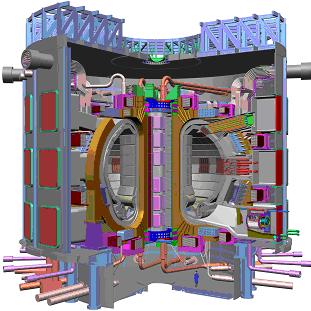
The programmatic goal of the international endeavour, ITER, is "to demonstrate the scientific and technological feasibility of fusion power for peaceful purposes". ITER will enable the fusion community to study plasmas in conditions similar to those expected in an electricity-generating fusion power plant.
ITER should produce 500 MW of fusion power with an energy amplification factor of at least 10. It will aim at demonstrating and testing a number of key technologies and processes essential for future fusion power plants, including superconducting magnets, and remote handling. It will also be used to test components for a future reactor, including prototypes of tritium breeding blankets.
The participants currently include the European Union, Japan, the People´s Republic of China, India, the Republic of Korea, the Russian Federation and the USA. Europe will contribute almost half of the costs of its construction, while the other six members will contribute equally to the rest.
The selection of a location for ITER took a long time and on June 28, 2005 it was officially announced that ITER will be built at the Cadarache site in the south of France. The ITER organization, which will administer the construction and operation of the machine, was formally created on November 21. According to the planned schedule, the first plasma is expected in 2018 and this will be followed by an exploitation phase lasting about 20 years.
Source: http://www.iter.org/a/pictures_html/iter_man_bottom-large.jpg

Future - Towards a Fusion Power Plant
In parallel to ITER construction and operation, an accompanying R&D programme will be carried out in both physics and technology in order to prepare for the subsequent step, DEMO, a fusion power reactor that will demonstrate electricity production.
This programme is likely to include an International Fusion Materials Irradiation Facility (IFMIF). This high-intensity neutron source is required to test and verify the performance of materials for future fusion reactors, in particular low activation materials. DEMO should demonstrate tritium fuel self-sufficiency and first electrical power production 30 to 35 years from the start of ITER construction, and will lead fusion into its industrial era.
The demonstration reactor, DEMO, is to be decided on around 2020. As compared to ITER, it is a power producing device which is fully equipped with reactor components, has an improved confinement system, is run in a steady state at a power of 2.5 GWth with an efficiency of Q=25, and has a mantle for generation of tritium.
A commercial power-producing reactor will be built after the performance of the DEMO has been shown to be satisfactory. However, a power-producing reactor cannot be fully designed until a reliable operation of the DEMO reactor has been proven. In any case, it will most likely be based on the DT reaction, and may have the form of a concept-improved tokamak, or possibly some other magnetic confinement system.
The Inertia Fusion Development
Despite the military implications, unclassified inertia fusion research has been conducted in Limeil (France), Garching (Germany), Rijnhuizen (Holland), and Darmstadt (Germany). The primary problems in making a practical inertia fusion device would be building a driver of the required energy and making its beams uniform enough to collapse a fuel target evenly.
The development of laser fusion to some extent is coupled with the development of high power lasers. In the 1970s, it was believed that laser driver as little as 1 kilojoules (kJ) would suffice to create the fusion conditions. As the various plasma instabilities and laser-plasma energy coupling loss modes were gradually understood, estimates of the laser energy needed to effectively compress the targets to ignition conditions has grown rapidly from the early estimates into the mega joule range (MJ). The latest research devices, such as the National Ignition Facility (NIF) in the US and the Laser Mégajoule (LMJ) in France, support investigations into this regime. These two devices adopt the indirect-drive scheme. Direct-drive scheme has been explored in the OMEGA up-grade in USA, the NIKE in USA, and the GEKKO XII in Japan.
In the traditional inertia fusion approach, the drivers (high energy beams) are used to both compress and heat the target. The driver compresses the fuel pellet to very high density and the shock wave created by this process further heats the compressed fuel (in analogous to a diesel engine in which the fuel is compressed until it ignites spontaneously). Efficient heating requires very symmetric compression process and driver energy in the range of mega joules is needed to create ignition conditions.
The recent works (e.g., GEKKO XII in Japan) demonstrated that significant savings in the required laser energy are possible using a technique known as "fast ignition", which decouples the heating and compression phases of the implosion. Instead of using the shock wave to heat the compressed fuel, this approach use a separate beam to directly heats the fuel to create the ignition conditions more efficiently. The laser system of GEKKO XII is being upgraded to further explore fast ignition to achieve ‘breakeven’ and ignition.
NIF, the world's largest laser, to be completed in 2009, will focus 192 giant laser beams delivering 1.8MJ of ultraviolet laser energy on a tiny D-T fuel pellet in the center of its target chamber – creating conditions similar to those that exist only in the cores of stars to initiate fusion reactions. The LMJ laser beam facility, being built in France, is designed to study high energy density plasmas and inertial confinement fusion. When completed, LMJ will have 240 laser beams that will deliver 1.8 MJ of energy to a target.
A European proposal for a High Power laser Energy Research facility (HiPER) aims to achieve high energy gains, providing the critical intermediate step between ignition and a demonstration reactor. It would consist of a long-pulse laser with an energy of 200 kJ to compress the fuel and a short-pulse laser with an energy of 70 kJ to heat it. If funded, the facility would be opened to the scientific community towards the end of next decade. At present, UK is the leading contender to host the HiPER laser facility.
Inertia fusion has reached near “breakeven” condition and the new devices are designed to demonstrate breakeven and ignition. There are major technical problems to be resolved before inertial fusion power plant can be realized. The lasers need to be much larger and more efficient than those existing today, the repetition rates need to be increased by orders of magnitude, the injection and tracking systems remains to demonstrate that the reactor requirements can be met, the manufacturing of the fuel pellets will require an entire industry using technologies not even demonstrated today, and the biggest challenge is to figure out how to integrate the system into a reactor.
After an exploratory phase with different magnetic confinement configurations, the magnetic fusion development in China has evolved to focus on the tokamak concept. Presently, the tokamaks in China include:
- HT-7 is a medium sized super-conducting tokamak in Institute of Plasma Physics, Chinese Academy of Sciences (ASIPP) in Hefei. Its main purpose is to explore high performance plasma operation under steady-state condition. Recently, it was also devoted to the study of the turbulence structures in the plasma edge and their propagation across magnetic surfaces. Another small tokamak HT-6M in ASIPP is used to study ICRF and transport.
- The South Western Institute of Physics (SWIP) in Chengdu has medium sized HL-1M tokamak, in which plasma heating and advanced fueling are investigated. The HL-2A is a divertor tokamak for exploring divertor related topics and also topics related to ITER.
- Other two small tokamaks in China are KT-5C in the University of Sciences and Technology of China (USTC) in Hefei and CT-6B in the Institute of Physics, Chinese Academy of Sciences (IP/CAS). They are operated for edge turbulence/transport study and alternative concept development.
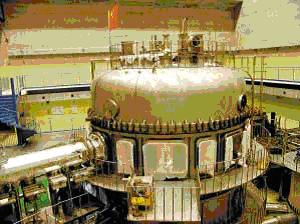
One of the latest tokamak is the EAST (Experimental Advanced Superconducting Tokamak). It is a mega-ampere full superconducting tokamak aiming at steady-state operation with the shaped plasma cross-section. It is an improvement over the earlier superconducting tokamak device, HT-7. Steady-state plasmas will be sustained by intensive use of radio frequency heating and current drive. The physics and technologies of long pulse operation with non-inductive current drive are essential basis for EAST.
EAST is also located in in ASIPP in Hefei. Construction was completed in March 2006 and on September 28, 2006, "first plasma" was achieved. In February 2007 the reactor sustained an electrical current of 250 kA for five seconds.
Source: http://news.sina.com/ch/phoenixtv/102-101-101-102/2008-01-22/14292618428.html
http://www.fusion-eur.org/main_body.htm
http://www.pppl.gov/fusionenergy.cfm
http://www-jt60.naka.jaea.go.jp/HOME.html
https://lasers.llnl.gov/programs/ife/how_ife_works.php
http://www.ile.osaka-u.ac.jp/zone3/explanation/what/index_e.html
http://www.cea.fr/english_portal/defense/the_simulation_program_lmj_tera_airix