


-
What is “Radiation”?
-
Applications of Ionizing Radiation
-
Radiation Protection Basics
-
Detecting Radiation
-
Radiation Protection Measures Implemented by Nuclear Power Plant
-
Environmental Radiation Monitoring and Assessment in Hong Kong
-
Useful Links
All matters in this world are made up of tiny particles called atoms. Every atom has a nucles and a surrounding cloud of electrons. When an unstable nucleus undergoes changes, invisible particles or waves are released. The particles and waves are called radiation. The unstable nucleus is said to be radioactive. The radiation which removes orbital electrons from atoms, thus creating ion pairs, is called ionizing radiation. If the ionization process occurs in living tissue, chemical changes would damage the cells and can lead to injury in the organism.
In a typical fission process in a nuclear power plant, an incoming neutron hits a uranium 235 atom to produce two lighter fission products together with some energy in the form of nuclear radiation and between 2 to 3 neutrons for further fission reactions.
Types of Ionizing Radiation
- Alpha particles – swiftly moving nuclei of helium atoms with positive charges.
- Beta particles – high speed electrons with more penetrating power than alpha particles.
- X-rays and gamma rays – penetrating rays passing through body.
- Neutrons – carrying no charge but with high penetrating power.
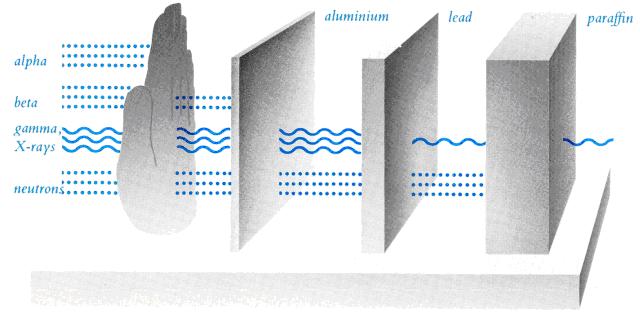
Common Types of Ionizing Radiation
Image Credit: Government Information Services, HKSARG
Sources of radiation
There are two generic sources of radiation – natural and artificial. Natural radiation includes cosmic ray from space and radiation emitted by radioactive substances that exist on food and habitat. Artificial radiation comes from radioactive fallout from nuclear testing, x-rays emissions from vacuum tubes, such as medical diagnostic machine, television and video display units, and use of radioactive materials in consumer products such as smoke detectors.
Ionizing radiation can be applied in different aspects to the benefits of the mankind:
- Electricity generation by means of commercial nuclear power stations.
- Medical applications in providing images for identification of abnormal changes in body organs and tissues as well as a major tool in the treatment of certain kinds of cancer.
- Industrial applications in detecting defects in welds and metal castings as well as quality adjustments and measurements in production lines.
- Consumer products such as smoke detectors, luminous signs and lightning conductors where the benefits and safety significantly outweigh the minimal radiation risks.
- Archaeological applications in assessment of the age of objects
Effect of Ionizing Radiation on Health
Although radiation may cause damages to body cells and tissues, health effects are insignificant unless the dose of radiation is large. The effect depends on the intensity of the radiation, the length of the exposure, and the type of body cell exposed. Sudden large doses of magnitude above 1,000 mSv to the whole body can cause acute radiation injuries, with short-term symptoms like nausea, vomiting, extreme tiredness and hair loss. A dose of 10,000 mSv or more can be fatal unless good medical attention is available.
According to the data provided by the Hong Kong Government, the radiation dose received by an average individual in daily life is very low. Even for workers who are exposed to radiation in their work, the average dose is about 0.05 – 0.11mSv/year.
Three basic concepts apply to all types of ionizing radiation, namely time, distance and shielding. When an authority develops regulations or standards that limit how much radiation a person can receive in a particular situation, these three concepts might affect a person’s exposure.
Time
The amount of radiation exposure increases and decreases with the time people spend near the source of radiation. In general, the exposure time should be assessed as how long a person is near radioactive material. Gamma and x-rays are the primary concern for external exposure.
Distance
The farther away people are from a radiation source, the less their exposure. How close to a source of radiation can a worker be without getting a high exposure? It depends on the energy of the radiation and the size (or activity) of the source. Distance is a prime concern when dealing with gamma rays, because they can travel long distances. Alpha and beta particles don’t have enough energy to travel very far.
As a rule, if you double the distance, you reduce the exposure by a factor of four. Halving the distance increases the exposure by a factor of four.
Shielding
The greater the shielding around a radiation source, the smaller the exposure. Shielding simply means having something that will absorb radiation between you and the source of the radiation (but using another person to absorb the radiation doesn't count as shielding). The amount of shielding required to protect against different kinds of radiation depends on how much energy they have.
- Alpha (a) – a thin piece of light material, such as paper, or even the dead cells in the outer layer of human skin provides adequate shielding because a-particles can't penetrate it. However, living tissue inside body, offers no protection against inhaled or ingested a-emitters.
- Beta (b) – additional covering, for example heavy clothing, is necessary to protect against b-emitters. Some b-particles can penetrate and burn the skin.
- Gamma (g) – thick, dense shielding, such as lead, is necessary to protect against g-rays. The higher the energy of the g-rays, the thicker the lead must be.
- X-rays – pose a similar challenge as g-rays, so x-ray technicians often give patients receiving medical or dental X-rays a lead apron to cover other parts of body.
According to International Commission of radiation Protection (ICRP), the annual individual dose limits is 20 mSv/year for a worker frequently in an exposure of radiation. Every nuclear power plant would have own maximum dose and would monitor each worker to ensure that none of them would receive the annual dose exceeding the ICRP standard.
Scientists have developed the following four major types of instrument to detect and identify radioactive materials and ionizing radiation.
Personal Radiation Detector (PRD)
A wearable gamma and/or neutron radiation detector, approximately the size of a pager. When exposed to elevated radiation levels, the device alarms with flashing lights, tones, and/or vibrations.
Handheld Survey Meter
Handheld radiation detector, which typically measures the amount of radiation present and provides this information on a numerical display in units of counts per minute, counts per second, or mSv per hour. Most of these devices detect beta and gamma radiation only. However, some models can detect alpha, beta, gamma, and/or neutron radiation emitted from radioactive materials.
Radiation Isotope Identification Device (RIID)
A radiation detector with the ability to analyze the energy spectrum of radiation, in order to identify the specific radioactive material (radionuclide) that is emitting the radiation
Radiation Portal Monitor (RPM)
A large pass-through radiation monitor (or "portal") for personnel, vehicles, container boxes, or trains. Typically, these devices consist of two pillars containing radiation detectors, which are remotely monitored from a display panel. These monitors alarm to indicate the presence of radioactive materials, including low-radiation materials like uranium.
Nuclear Safety Surveillance
- The objectives of nuclear safety surveillance in nuclear power plant are to:
- verify the implementation of safety regulatory requirements;
- perform surveillance on the correction of non-conforming items;
- justify the qualification of the personnel related to nuclear safety;
- ensure that materials, components, structures, systems, and activities are conforming to nuclear safety requirements; and
- ensure reporting of any defect and abnormal event in time.
In China, the National Nuclear Safety Administration (NNSA) requests that the management of nuclear power plant should eliminate unsafe factors of items and activities in nuclear installation in order to protect the site personnel, the public and the environment from possible adverse effects arising from the nuclear installations. NNSA will take enforcement action and order the nuclear power plant to take safety measures or to stop plant activities where necessary.
Processing of Radioactive Effluents Before Release
All gaseous and liquid effluents from nuclear power plant are processed before being released into the environment. Contaminated gases pass through waste treatment systems involving filters and iodine absorbers and are retained in storage tanks for several weeks to allow radioactivity to decay. Radioactive liquids are filtered and further processed in an ion-exchanger or an evaporator. When the effluents meet statutory requirements, they are diluted with large cooling water flow and discharged into the sea.
Sophisticated radiation monitoring and alarm systems are installed at nuclear power plant to assess and control the radioactivity levels of normal releases.
Monitoring and Control of Radioactivity in the Environment
An important part of the nuclear power station is the monitoring of radioactivity levels in air, dust, sea and fresh water, soil and sediment, land and marine plants, and animals in the vicinity of the power station. During the operation, ambient gamma radiation will be continuously measured at some atmospheric monitoring stations away from the nuclear power plant. Regular and automatic sampling for waterborne radioactivity measurement will take place at a liquid discharge monitoring station in the cooling water discharge channel.
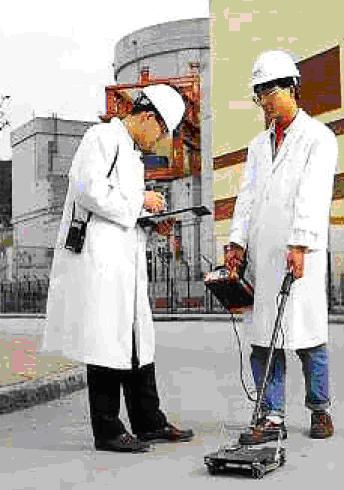
Regular Monitoring of Radioactivityin the vicinity of Nuclear Power Plant
Image Credit: HKNIC
For the nuclear power stations at Daya Bay and Lingao, Guangdong, which are about 50 km from Hong Kong, the power stations have respectively set up three atmospheric monitoring stations and four gamma radiation monitoring stations about 1 km and 5 km away from the power stations.
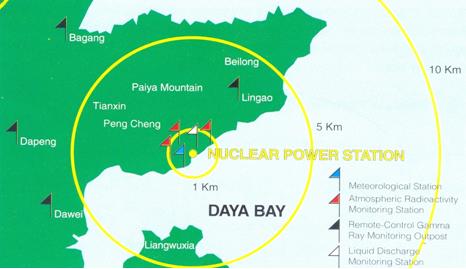
Environmental Monitoring Stations set up by Guangdong Nuclear Power Station
Image Credit : HKNIC
To ensure that our environment is not adversely affected by the operation of the nuclear power stations at Daya Bay and Lingao, the Hong Kong Observatory (HKO) implements an environmental radiation monitoring programme since 1987. A radiation monitoring network consisting of 10 fixed radiation monitoring stations has been set up to monitor the ambient gamma dose rate in Hong Kong. An alarm at the HKO Headquarters will sound when the radiation level at any one station exceeds pre-set criteria. The measurement results collected so far show that there is no observable increase in the radiation level in the environment of Hong Kong. Details of measurements are published in the monthly reports of the HKO.
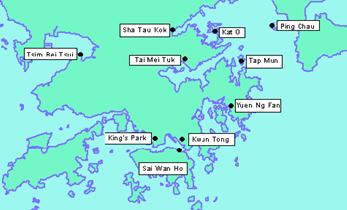
Fixed MonitoringStations set up by HKO
Image Credit: HKO
Radiation Health and Safety arising from the Use of Ionization Radiation in Hong Kong
The Radiation Health Unit (RHU) is one of the specialized health service units in the Department of Health. Its objective is to provide effective advice and services to protect the health of workers and members of the public from deleterious effects arising from the use of ionizing radiations in Hong Kong.
Services provided include:
- Radioactive Substance and Irradiating Apparatus Licensing Service;
- Permits to transport radioactive substances;
- Medical examination of radiation workers;
- Provision of personal radiation monitoring services;
- Provision of environmental radiation monitoring services; and
- Provision of radiological protection advice and services in general.
- Understanding Radiation
Radiation Health Unit, HKSARG
http://www.info.gov.hk/dh-rhu/understand_rad_english.htm
Hong Kong Observatory, HKSARG
http://www.hko.gov.hk/education/dbcp/radiation/eng/r1.htm?menu=radiation - Radiation Protection Basic
Radiation Health Unit, HKSARG
http://www.info.gov.hk/dh-rhu/BASICSST.pdf
Hong Kong Observatory, HKSARG
http://www.hko.gov.hk/education/dbcp/rad_protect/eng/r1.htm?menu=rad_protect
US Nuclear Regulatory Commission
http://www.nrc.gov/about-nrc/radiation/health-effects/detection-radiation.html - Radiation Protection Measures by Nuclear Power Plant
Hong Kong Nuclear Investment Company Ltd.
http://www.hknuclear.com/nflash/eng/html/CLP_Nuclear.pdf
http://www.hknuclear.com/nflash/eng/html/shome.htm
National Nuclear Safety Administration, China
http://www.nti.org/db/China/nnsa.htm
China Guangdong Nuclear Power Group
http://www.cgnpc.com.cn/n1093/n14688/index.html - Radiation Monitoring and Assessment in Hong Kong
Hong Kong Observatory, HKSARG
http://www.hko.gov.hk/radiation/ermp/frontpage/monitoring_env.htm?chinese=0&flash=1 - Radiation and Health
Hong Kong Observatory, HKSARG
http://www.hko.gov.hk/education/dbcp/rad_health/eng/r1.htm?menu=rad_health
Radiation Health Unit, HKSARG
http://www.info.gov.hk/dh-rhu/english_aboutus.htm