

-
Principle of Nuclear Power Station
-
Main Reactor Types
-
Issues in Nuclear Power Development
-
World Development in Nuclear Power
-
Nuclear Power in Mainland China
-
Useful Links
Nuclear Fission Process
Few materials are suitable for nuclear fission. Materials that can easily undergo the fission process are known as “fissile”. They include uranium 233, uranium 235 and plutonium 239. Materials that can undergo the fission process, with some difficulties, are known as “fissionable”. They include thorium 232, uranium 238 and plutonium 240. Of these 6 nuclides, only thorium 232, uranium 235 and uranium 238 are found in nature.
To obtain nuclear energy for commercial use, uranium 235 is the obvious choice for nuclear fission since it is fissile and is reasonably plentiful in nature, even though it makes up only 0.7% in natural uranium, with the remaining being largely uranium 238.
In a “nuclear fission”, an incoming neutron hits a uranium 235 atom to form an unstable uranium 236 atom. It then splits to give two atoms of usually unequal mass, two or three neutrons and much energy. The neutrons thus produced may hit other uranium 235 atoms to produce further nuclear fission to maintain a “chain reaction”.
Thermal Neutron Reactor
Thermal reactor uses uranium having a low enrichment of uranium 235, at 3% - 5%, as a nuclear fuel to produce heat.
At low uranium 235 enrichment, it is necessary to slow down a neutron in a process known as “moderation” to increase its probability to initiate a nuclear fission event. The neutron is known as a “thermal neutron”. Water (light or heavy) and graphite are suitable material for moderation.
Heat produced in the reactor by nuclear fission is taken away by a coolant. Common coolants for the reactor include water, carbon dioxide and helium.
Fast Neutron Reactor
A Fast Neutron Reactor usually uses a mixture of uranium 235 and plutonium 239 having about 25% enrichment.
At this level of enrichment, there is no need to slow down the neutrons before starting the fission process. Hence the use of “fast neutrons” and there is no need for a “moderator.”
The reactor core is more compact than a thermal reactor because the fast reactor has a higher enrichment. Liquid metal is used as a reactor coolant because it is a very efficient heat transfer medium.
Nuclear Steam Supply System
Heat produced in the reactor is taken away by a coolant often to a heat exchanger to raise steam.
The steam is used sometimes for process heat but most often to drive a turbine-generator to produce electricity.
Engineering Safety Features
Engineering safety features are used to maintain a proper level of safety –
- To control nuclear reaction: inserting rods containing neutron absorbing material such as cadmium, iridium or boron, known as “control rods”, or injecting a neutron absorbing material into the reactor to regulate or even suppress the nuclear reaction.
- To maintain cooling: reactor cooling is maintained by duplicate engineering cooling systems and/or by engineering features that make use of natural convection phenomenon.
- To prevent an unintentional leak of radiation: use of reliable physical barriers built to a high standard to contain radioactivity found in the reactor.
By using various engineering safety features and by prudent operation according to established procedures, a modern nuclear power station may keep its risk to the public and the environment at a level very much lower than the risks found in our daily experience.
Most of the six main reactor types were developed in the 1950’s though not all were fully exploited for commercial applications. Of these six reactor types, only fast neutron breeder reactor makes use of fast neutrons for nuclear fission, while the other five make use of thermal neutrons for nuclear fission. These five are collectively called thermal neutron reactors.
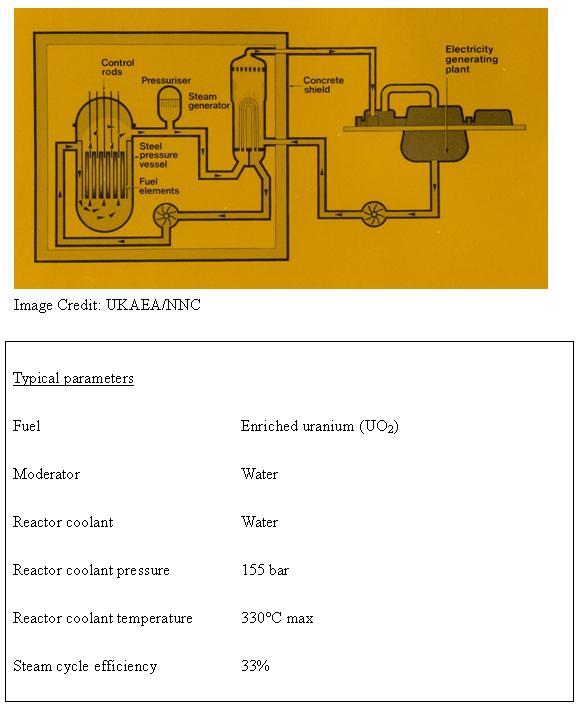
Pressurised Water Reactor
In a pressurised water reactor, enriched nuclear fuel undergoes nuclear fission in an enclosed pressure vessel. Water is used both as a coolant for the nuclear fuel and as a moderator to maintain the nuclear fission process. The water for cooling the nuclear fuel is separated from the water used to produce steam for the turbine-generator. A certain portion, typically 25 to 40 percent, of each store of nuclear fuel will need to be replaced in between 12-24 months.
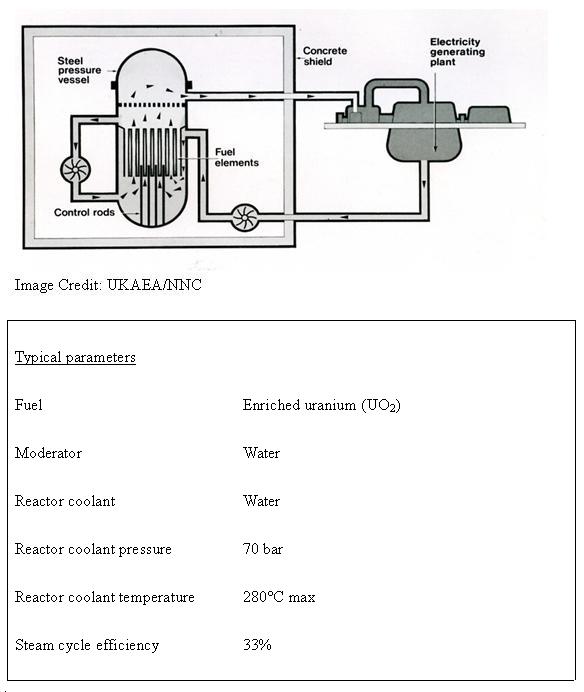
Boiling Water Reactor
In a boiling water reactor, enriched nuclear fuel undergoes nuclear fission in an enclosed pressure vessel. Water is used both as a coolant for the nuclear fuel and as a moderator to maintain the nuclear fission process. The water for cooling the nuclear fuel is allowed to boil in the reactor pressure vessel above the reactor core, to produce steam for the turbine-generator. A certain portion, typically 25 to 40 percent, of each store of nuclear fuel will need to be replaced in between 12-24 months.
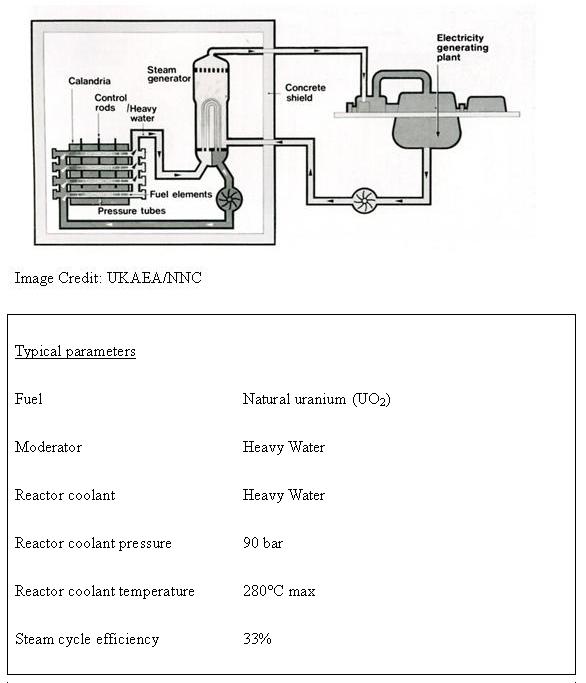
Pressurised Heavy Water Reactor
In a pressurised heavy water reactor, natural nuclear fuel undergoes nuclear fission inside a bundle of pressure tubes containing heavy water for cooling. The tube bundle is placed inside a vessel, known as calendria, containing heavy water as a moderator to maintain the nuclear fission process. The heavy water for cooling the nuclear fuel is separated from the light water used to produce steam for the turbine-generator. The nuclear fuel in a pressure tube can be replaced when the reactor is operating.
Light Water Graphite Moderated Reactor
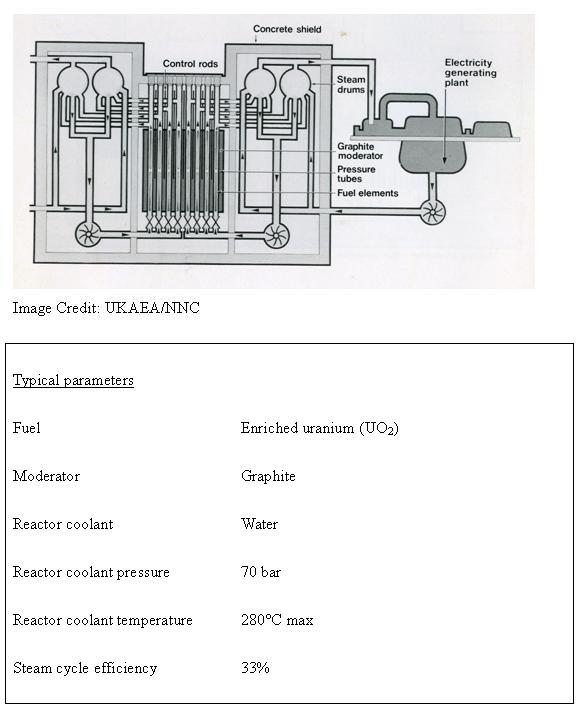
In a light water graphite moderated reactor, enriched nuclear fuel undergoes nuclear fission inside a bundle of pressure tubes containing light water for cooling. The tube bundle is placed inside a graphite structure which provides moderation. The water which has cooled the nuclear fuel is collected in steam drums, to produce steam for the turbine-generator. The nuclear fuel in a pressure tube can be replaced when the reactor is operating.
Gas Cooled Reactor
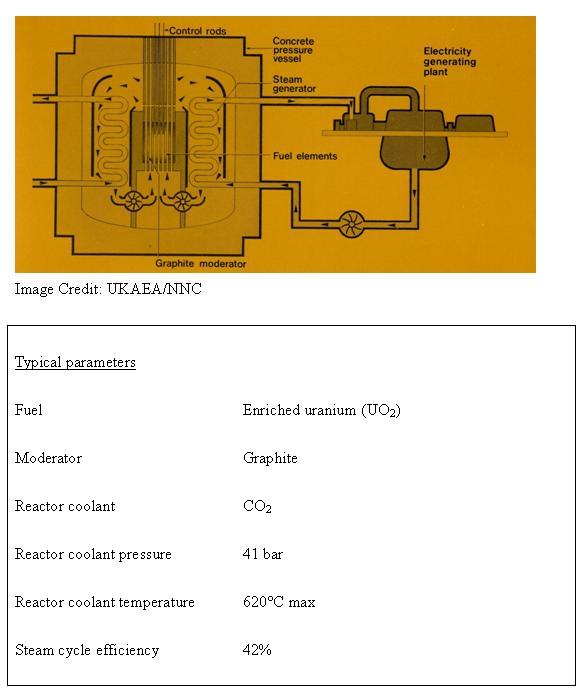
In a gas cooled reactor, natural/enriched nuclear fuel undergoes nuclear fission inside channels of a graphite structure which provides moderation. Gas is used as a coolant for the nuclear fuel and takes the heat to a steam generator to produce steam for the turbine-generator. The nuclear fuel can be replaced when the reactor is operating.
Fast Neutron Breeder Reactor
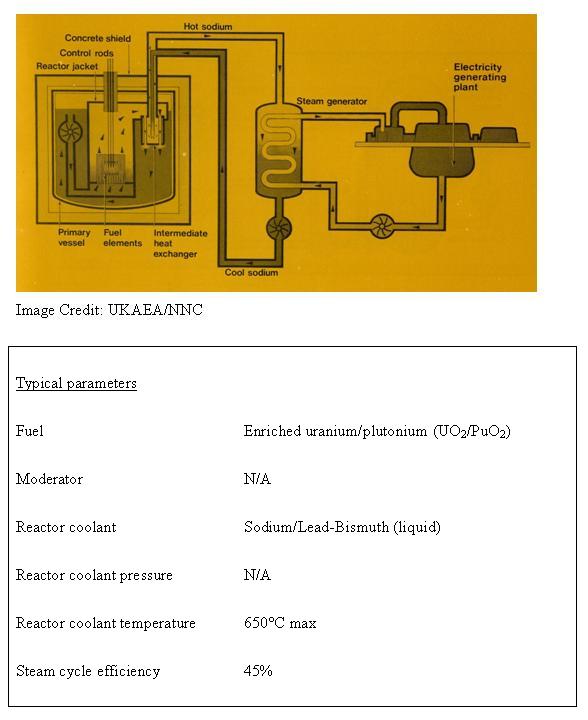
In a fast neutron breeder reactor, enriched nuclear fuel undergoes nuclear fission inside a reactor core. A blanket of fissionable material is placed around the reactor core to capture any excess neutron to transform into fissile material. Liquid metal is used as a coolant for the nuclear fuel and takes the heat to a steam generator to raise steam for the turbine-generator. The nuclear fuel can be replaced when the reactor is operating.
Environmental Impact
The nuclear power station operates a purification process for the reactor cooling system to take radioactive substance continuously out of the reactor coolant so as to prevent its level of radioactivity from increasing. The purification process will remove most of the radioactivity for separate storage as nuclear waste but the process will release a very small proportion of the radioactivity as liquid effluent and gaseous discharge into the environment.
While the amount of release is small, it is nevertheless necessary to monitor its impact on the environment. It is a standard international practice for both the station operator and the national regulator to monitor continuously for any long term changes of radioactivity in the environment around a nuclear power station, to ensure that any change remains insignificant.
Used Nuclear Fuel and Nuclear Waste Management
Nuclear fission in the nuclear reactor will convert the nuclear fuel material into fission products and slowly reduces the amount of fissile material in the nuclear fuel. The nuclear fuel becomes used when its concentration of fissile material is no longer high enough to maintain the fission process in the nuclear reactor.
The used nuclear fuel will be taken out of the nuclear reactor and it is highly radioactive, and after a period of storage in the nuclear power station to allow its radioactivity to reduce sufficiently for easy handling, can be disposed of as a waste. An alternative is to carry out chemical treatment to take out the remaining fissile and fissionable material in the used fuel and put away the small amount of residual waste material (at typically 3-5%) and which is highly radioactive. In either case, the highly radioactive nuclear waste will need long-term storage so that it will not affect the environment.
Other nuclear waste is produced when purifying the reactor cooling system and maintaining the nuclear power station. The waste is less radioactive but it will also need long-term isolation from the environment.
On the basis of a unit of electricity produced, the waste that comes from nuclear power generation is only a small fraction of the waste from coal or gas fired power generation, and is comparable in quantity to that from renewable energies.
Nuclear Power Station Decommissioning
A nuclear power station operates typically for 30-60 years. The lifespan is generally determined by the life of certain key components close to the reactor and sustaining a slow change in mechanical properties because of radiation.
At the end of its life, a nuclear power station will be decommissioned in a long process by first taking away the nuclear fuel from the power station and dismantling station building and structure not classified as radioactive. The reactor building and other structure that are affected by radiation will be segregated until their radiation has become low enough for them to be dismantled conveniently. The site will then return to general use.
Nuclear power stations that were built in the 1950’s have been decommissioned or are being decommissioned. They show that nuclear power station decommissioning can be done without too many practical difficulties.
Nuclear Power Economics
In general, a nuclear power station has a high construction cost and a low running cost when compared to a power station burning coal or gas. It is therefore advantageous to operate a nuclear power station at its full capacity because it will have relatively little additional cost. It is also less sensitive to uncertainties to future cost factors such as market fluctuation and inflation so it offers a more predictable and stable cost for the future.
In many countries, the operators of nuclear power stations have included the costs of handling nuclear waste and decommissioning in the price of nuclear electricity, so that money is available to finance future nuclear liabilities such as managing nuclear waste and station decommissioning.
While it is difficult to compare costs between countries often because of different national policies and different basis for cost calculations, comparisons available in a country have generally shown that nuclear electricity is competitive with electricity produced with fossil fuels.
Climate Changes
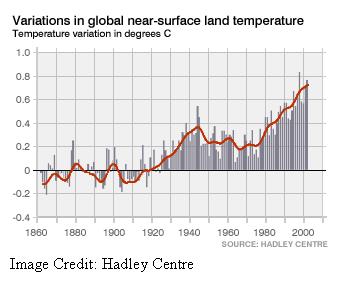
The increase in atmospheric temperature in the last century has generally been attributed to the steady increase in the atmospheric concentration of carbon dioxide as a result of human activities since the Industrial Revolution, particularly the large scale use of fossil fuels.
If left unchecked, the increase in carbon dioxide concentration is expected to have profound effect on world climate changes and on our general well-being.
Nuclear energy is expected to have a prominent role in mitigating the impact since apart from renewable energies, it does not emit any significant amount of carbon dioxide or other greenhouse gases.
Statistics on World Nuclear Power Stations
There were 440 operable nuclear generating units in the world at the end of 2009, having a total gross capacity of 394,600 MW, contributing 2,550 TWh in the year and 14% to worldwide electricity generation.
| Reactor Type | Number (end of 2009) | Installed capacity (GW) | Main countries |
|---|---|---|---|
| Pressurised Water Reactor | 266 | 258 | US, France, Germany, Japan, Russia, Korea |
| Boiling Water Reactor | 92 | 88 | US, Japan, Sweden |
| Pressurised Heavy Water Reactor | 47 | 26 | Canada |
| Light Water Graphite Moderated Reactor | 11 | 11 | Russia |
| Gas Cooled Reactor | 18 | 11 | UK |
| Fast Breeder Reactor | 2 | 1 | Japan, Russia, France |
| Others | 4 | ||
| Total | 440 | 395 |
International Nuclear Power Development Programmes and Initiatives
At the end of 2010, there were 52 nuclear power generating units under construction in the world, equivalent to 13% of the installed world capacity. They were found mainly in China, India, South Korea and Russia.
The continuous worldwide improvement in the performance of nuclear power stations over the last two decades, the rising cost of fossil fuels and the recognition of man-made causes of climate change have led to a renewed interest in nuclear power.
At the turn of the century, several new evolutionary reactor designs have been put forward. They are generally called Generation III Reactors, having a much higher safety margin and generally better economics than existing reactor designs. In China, the AP1000 design from Westinghouse, US being built in Sanmen and Haiyang, and the EFR design from Areva, France being built in Taishan, belong to this generation.
In 2001, a group of Western countries that recognized the role of nuclear energy chartered the Generation IV Internal Forum (GIF), to be joined by the EU, Russia and China in 2006. GIF late in 2002 announced the selection of six reactor technologies which they believe represent the future shape of nuclear energy, according to cleanliness, safety and economics. In addition to selecting these six designs for deployment by 2030, the GIF recognized a number of International Near-Term Deployment advanced reactors available before 2015.
The International Framework for Nuclear Energy Cooperation (IFNEC), formerly the Global Nuclear Energy Partnership (GNEP) which was established by the USA in 2006, aims to accelerate the development and deployment of advanced nuclear fuel cycle technologies while providing greater disincentives to the proliferation of nuclear weapons. It is joined by the USA, France, China, Japan and Russia.
In 1994, the first indigenous nuclear power station in Mainland China entered commercial operation at Qinshan in Zhejiang and the first large-scale commercial nuclear power station entered commercial operation at Daya Bay in Guangdong.
There were 11 nuclear power generating units operating at the end of 2009, consisting of 9078 MW gross of installed nuclear generating capacity. They are located in Qinshan Nuclear Power Base in Zhejiang (3010 MW), Daya Bay Nuclear Power Base in Guangdong (3948 MW) and Tianwan Nuclear Power Station in Jiangsu (2120 MW).
Based on a strategic plan for nuclear power development endorsed by the State Council for 2005-2020, there is also an active reactor construction programme aiming at meeting 40,000-60,000 MW of operating capacity by 2020, equivalent to putting in two to three large nuclear generating units per year for the next fifteen years, to supply about 4% of the annual national consumption of electricity.
The construction is matched by the enhancement of university education and research institutes, and of indigenous manufacturing capability in for example heavy forging, nuclear grade equipment and turbine-generator sets.
There were also 6 operating nuclear power generating units in Taiwan at the end of 2009, with another 2 under construction.
Qinshan Nuclear Power Base
Qinshan Nuclear Power Base is located on a peninsula at the Hai Yan County, Zhejiang Province, on the northern shore of Hangzhou Bay. It is about 90 km from Hangzhou and 120 km from Shanghai. It is about 10 km west of the nearest town Haiyan.
The site contains three operating nuclear power stations, namely Qinshan 1, Qinshan 2 and Qinshan 3, and one nuclear power station Qinshan 2 Phase 2 under construction. China National Nuclear Corporation (CNNC) is the majority shareholder, if not the sole shareholder, of these 3 power stations. At the site, Qinshan 2 is 3 km south of Qinshan 1, and Qinshan 3 is 0.8 km east of Qinshan 1.
1) Qinshan Nuclear Power Station
Qinshan Nuclear Power Station, also known as Qinshan 1 Nuclear Power Station, is the first civil nuclear power station in Mainland China. It is a single 300 MW PWR nuclear power station using indigenous technology. About 95% of the equipment of Qinshan Nuclear Power Station was designed and manufactured in the Mainland. The remaining 5% of the equipment was imported, being mainly major items.
Qinshan Nuclear Power Station began construction in 1985, reaching first criticality in October 1991 and commercial operation in April 1994. The construction cost was RMB 1.6 billion.
Qinshan Nuclear Power Station operates a 15 month fuel cycle. Its recent annual capacity factor is typically at about 90%.
2) Qinshan 2 Nuclear Power Station
Qinshan 2 Nuclear Power Station is an indigenous development based on French technology. It is a twin 650 MW class PWR nuclear power station designated as CNP 650. It has many similarities to the Framatome M310 series though having only two primary coolant loops and not three. It is developed upon proven technology, based on national standards while conforming to international practices. Each unit has a gross output nominally at 670 MW, with a maximum at 690 MW, making it the largest two-primary loop PWR design. It achieved 55% localization in construction and has a planned life of 40 years while extendable to 60 years.
The station began construction in 1996, with the first unit reaching commercial operation in April 2002 and the second unit in May 2004. The investment cost was RMB 14.4 billion.
Its annual capacity factor is typically above 80% after reaching full commercial operation in 2004.
3) Qinshan 3 Nuclear Power Station
Qinshan 3 Nuclear Power Station was built by AECL of Canada as a turn-key project. It is a twin-700 MW class Canadian Deuterium Uranium (CANDU) nuclear power station, using Pressurised Heavy Water Reactor (PHWR) technology. It has the following salient features:
- Reactor thermal output at 2064 MW and gross electrical output at 750 MW
- A design life of 40 years
- A designed capacity of 85%
- Natural uranium as fuel
- Heavy water as moderator and primary coolant, with the moderator and primary coolant in separate circuits
- Capable of refuelling during reactor operation
The station began construction in 1998, with the first unit reaching commercial operation in December 2002 and the second unit in July 2003. The investment cost was about USD 2.6 billion.
Its annual capacity factor is typically at around 90%.
4) Site development
Construction commenced for Qinshan 2 Nuclear Power Station (Phase 2) in 2006, for another twin 650 MW class PWR nuclear power station based on the same design as Qinshan 2 Nuclear Power Station. Phase 2 is forecast for completion in 2012 and with 70% localization in contents.
Construction also began in 2008 at Fangjianshan, located at about 0.6km south west to Qinshan 1 Nuclear Power Station. A twin-unit CPR 1000 PWR nuclear power station (at 1080 MW each) is being built for full commercial operation by 2014.
5) Technical Data of the nuclear power stations at Qinshan
| Qinshan Nuclear Power Station | Qinshan 2 Nuclear Power Station | Qinshan 3 Nuclear Power Station | |
|---|---|---|---|
| Reactor Type | PWR | PWR | PHWR |
| Reactor Model | CNNC | CNNC CNP 600 | AECL CANDU 6 |
| No of generating units | 1 | 2 | 2 |
| Power | |||
| NSSS thermal power | 966 | 2064 | |
| Gross electrical power | 300 | 650 | 750 |
| Net electrical power | 288 | ||
| Reactor core and fuel | |||
| Active core height/ length | 2.9m | 5.9m | |
| Active core diameter | 2.5m | ||
| Fuel inventory | 40.8 t Heavy Metal | 87.6 t Heavy Metal | |
| Number of assemblies/ bundle | 121 | 4560 | |
| Fuel | UO2 | UO2 | UO2 |
| Fuel enrichment, initial core | 2.4%, 2.67%, 3.0% | 2.4%, 2.67%, 3.0% | 0.7% |
| Fuel enrichment, reload | 3.0% | 3.4% | 0.7% |
| Number of fuel rods per assembly/bundle | 204 | 225 | 37 |
| Fuel rod configuration | 15X15 square | 15X15 square | Cylindrical cluster |
| Fuel cycle length | 15 months | N/A | |
| Reactor cooling system | |||
| Coolant | Light water (H2O) | Light water (H2O) | Heavy water (D2O) |
| Operating pressure | 155 bar | 115 bar | |
| Core inlet coolant temperature | 288.8°C | 266°C | |
| Core outlet coolant temperature | 315.2°C | 310°C | |
| Coolant mass flow | 24000 t/h | 32800 t/h | |
| No of loops | 2 | 2 | 2 |
| No of primary pumps | 2 | 2 | 4 |
| No of steam generators | 2 | 2 | 4 |
| Reactor pressure vessel | Upright cylindrical | Upright cylindrical | Horizontal cylindrical pressure tubes |
| Steam Generators | Upright, U-tube | Upright, U-tube | Upright, U-tube |
| Containment | Pre-stressed concrete cylindrical, single shell | Pre-stressed concrete cylindrical, single shell | Pre-stressed concrete cylindrical, single shell |
| Steam cycle | |||
| Steam flow rate | 1870 t/h | 3719 t/h | |
Steam pressure (SG outlet) | 51.9 bar | 47.0 bar | |
| Steam moisture (SG outlet) | 0.25% | ||
| Steam temperature (SG outlet) | 260°C | ||
Feedwater temperature (SG inlet) | 187°C | ||
| Turbine Generator | |||
| Turbine | 1 double flow HP 2 double flow LP | 1 double flow HP 2 double flow LP | 1 double flow HP 2 double flow LP |
| Generator | 300 MW | 650 MW | 750 MW |
| Speed | 3000 rpm | 3000 rpm | 3000 rpm |
| Condenser | Sea water cooling | Sea water cooling | Sea water cooling |
Daya Bay Nuclear Power Base
Daya Bay Nuclear Power Base is located on the Daipeng Peninsula in eastern part of Shenzhen Municipality, Guangdong Province, on the western shore of Daya Bay. It is about 50 km form the city centre of Hong Kong and 45 km from the centre of Shenzhen City. The nearest town is Dapeng, about 7 km from the nuclear power base.
The site contains two operating nuclear power stations, namely Daya Bay and Ling Ao, and one nuclear power station Ling Ao Phase 2 under construction. China Guangdong Nuclear Power Holding Company (CGNPC) is the shareholder, except for Daya Bay at which the CLP Group in Hong Kong holds a 25% equity. Ling Ao is about 1 km to the east of Daya Bay.
1) Guangdong Daya Bay Nuclear Power Station
Guangdong Daya Bay Nuclear Power Station, also known as Daya Bay Nuclear Power Station, is the first civil nuclear power station of a commercial capacity in Mainland China. It is a twin 900 MW class PWR nuclear power station using Framatome reactor technology and GEC-Alsthom turbine-generator technology. Most of the equipment of the station was imported from France or the UK.
Guangdong Daya Bay Nuclear Power Station began construction in 1987, reaching first criticality in 1993 and commercial operation in February 1994 and May 1994 for the two units. Seventy percent of its electricity is purchased by CLP in Hong Kong. The construction cost was USD 4 billion.
The station operates an 18 month fuel cycle. Its recent annual capacity factor is at about 90%.
2) Ling Ao Nuclear Power Station
Ling Ao Nuclear Power Station is a twin 990 MW PWR nuclear power station taking reference to the design of Daya Bay with a number of upgrades and an increase of local contents to 30%.
The station began construction in 1996, reached first criticality in February 2002 and commercial operation in May 2002 and January 2003 for the two units. The construction cost was USD 3.7 billion.
Typical recent annual capacity factor is at about 90%.
3) Site development
Construction began for Ling Ao Nuclear Power Station (Phase 2) in December 2005, for a twin 1000 MW class PWR nuclear power station as a demonstration project of the CGNPC twin 1080 MW CPR-1000 design. The indigenous design makes reference to the Daya Bay/Ling Ao design and has the following features:
- A 60 year design life
- Digital station control
- Turbine generator at 1500 rpm
- 50% localization or above
First grid connection was reached in July 2010 and commercial operation of the two units is planned for late 2010 and mid2011.
4) Technical Data of the nuclear power stations at Daya Bay
| Guangdong Daya Bay Nuclear Power Station | Ling Ao Nuclear Power Station | Ling Ao Nuclear Power Station (Phase 2) | |
|---|---|---|---|
| Reactor Type | PWR | PWR | PWR |
| Reactor Model | Framatome M310 | Framatome M310 | CPR 1000 |
| No of generating units | 2 | 2 | 2 |
| Power | |||
| NSSS thermal power | 2905 | 2905 | 2905 |
| Gross electrical power | 984 | 990 | 1080 |
| Net electrical power | 944 | 950 | 1020 |
| Reactor core and fuel | |||
| Active core height/ length | 3.66m | 3.66m | 3.66m |
| Active core diameter | 3.04m | 3.04m | 3.04m |
| Fuel inventory | 72.4 t Heavy Metal | 72.4 t Heavy Metal | 72.4 t Heavy Metal |
| Number of assemblies/ bundle | 157 | 157 | 157 |
| Fuel | UO2 | UO2 | UO2 |
| Fuel enrichment, initial core | 1.8%, 2.4%, 3.1% | 1.8%, 2.4%, 3.1% | 1.8%, 2.4%, 3.1% |
1.8%, 2.4%, 3.1% Fuel enrichment, reload | 4.45% | 3.7% | 4.45% |
| Number of fuel rods per assembly/bundle | 264 | 264 | 264 |
| Fuel rod configuration | 17X17 square | 17X17 square | 17X17 square |
| Fuel cycle length | 18 months | 12 months | 12 to become 18 months |
| Reactor cooling system | |||
| Coolant | Light water (H2O) | Light water (H2O) | Light water (H2O) |
| Operating pressure | 155 bar | 155 bar | 155 bar |
| Core inlet coolant temperature | 293°C | 293°C | 293°C |
| Core outlet coolant temperature | 327°C | 327°C | 327°C |
| Coolant mass flow | 68500 t/h | 68500 t/h | 68500 t/h |
| No of loops | 3 | 3 | 3 |
| No of primary pumps | 3 | 3 | 3 |
| No of steam generators | 3 | 3 | 3 |
| Reactor pressure vessel | Upright cylindrical | Upright cylindrical | Upright cylindrical |
| Steam Generators | Upright, U-tube | Upright, U-tube | Upright, U-tube |
| Containment | Pre-stressed concrete cylindrical, single shell | Pre-stressed concrete cylindrical, single shell | Pre-stressed concrete cylindrical, single shell |
| Steam cycle | |||
| Steam flow rate | 1615 t/h | 1615 t/h | |
Steam pressure (SG outlet) | 68.9 bar | 68 bar | |
| Steam moisture (SG outlet) | 0.25% | 0.25% | |
| Steam temperature (SG outlet) | 284°C | 284°C | |
Feedwater temperature (SG inlet) | 226°C | 226°C | |
| Turbine Generator | |||
| Turbine | 1 double flow HP 3 double flow LP | 1 double flow HP 3 double flow LP | 1 double flow HP 3 double flow LP |
| Generator | 984 MW | 990 MW | 1080 MW |
| Speed | 3000 rpm | 3000 rpm | 1500 rpm |
| Condenser | Sea water cooling | Sea water cooling | Sea water cooling |
Tianwan Nuclear Power Station Site
Tianwan Nuclear Power Station Site contains a twin 1060 MW VVER (Russian PWR) nuclear power station. China National Nuclear Corporation is the majority shareholder of the nuclear power station. The station was jointly built by CNNC and Atomstroyexport (ASE) from Russia.
The site is located at Lianyungang Municipality in northern Jiangsu, on the shore of the Yellow Sea and named after a local fishing village. It has a capacity to take 2 additional generating units, and may accommodate another 4 similar units.
Tianwan Nuclear Power Station is classified as Type AES-91 (sometimes also known as VVER 1000/428), adopting the Russia VVER 1000/V320 technology. It has the following salient features:
- Reactor thermal output at 3300 MW and gross electrical output at 1060 MW
- A design life of 40 years
- A designed capacity of 80%
- Uranium with 4.1% fuel enrichment for an 18 month fuel cycle
- Light water as moderator and primary coolant
- Digital station control system
- Double-wall pre-stressed cylindrical concrete containment building
- Core catcher beneath the reactor vessel to accommodate a molten reactor core in a hypothetical core melt accident
- Probability for severe radiological release less than 1 in 107 reactor year.
The station began construction in 1999, with the two units reaching commercial operation in May and August 2007. The investment cost was reported at USD 3.2 billion.
Other Nuclear Power Stations under development in 2010
China Guangdong Nuclear Power Company (CGNPC) entered into an agreement with China Power Investment (CPI) to construct a twin CPR 1000 PWR nuclear power station in Hongyanhe, Liaoning Province. Construction began in 2007 for full commercial operation in 2012. The two partners began the construction of another twin CPR 1000 PWR nuclear power station in 2009 at the same site for full commercial operation in 2014.
CGNPC entered into an agreement with Datang to construct a twin CPR 1000 PWR nuclear power station in Ningde, Fujian Province. Construction began in 2007 for full commercial operation in 2012. The two partners began the construction of another twin CPR 1000 PWR nuclear power station in 2010 at the same site for full commercial operation in 2015.
CGNPC began construction at Yangjiang in 2008 for four CPR 1000 PWR units for commercial operation in 2013 – 2016. Two CPR 1000 units are expected to follow at the same site. CGNPC entered into an agreement of cooperation intent with the CLP group in Hong Kong and the Guangdong Yuedian Group in Guangdong in 2010 for these two partners to each take a 17% share in Yangjiang.
China National Nuclear Corporation (CNNC) began construction of a twin CPR 1000 PWR nuclear power station in Fuqing, Fujian Province. Construction began in 2008 for full commercial operation in 2014. Four more units are expected to follow at the site.
CNNC also cooperates with the China Huaneng Group to construct a twin CNP 600 nuclear power station at Changjiang, Hainan Province. Construction began in 2010 for full commercial operation by 2015.
State Nuclear Power Technology Corporation (SNPTC) entered into an arrangement with Westinghouse in December 2006 to supply four AP 1000 PWR (at nominally 1250 MW each) to Sanmen, Zhejiang Province and Haiyang, Shandong Province and to provide technology transfer. These two project sites are primarily owned by CNNC and CPI respectively. Construction began at Sanmen in 2009 for full commercial operation in 2014, and at Haiyang in 2010 for full commercial operation in 2015.
In November 2007, CGNPC entered into an agreement with Areva in France to supply two European Pressurized Water Reactor (EPR) at Taishan (at nominally 1700 MW each) and to provide technology transfer. Construction began in 2009 for full commercial operation in 2014. Electricite de France has a 30% share in the project.
Work is also in progress to develop nuclear power stations for inland provinces, and to introduce more advanced reactor designs for power generation. A 210 MW high temperature gas cooled reactor plant is planned at Shidaowan, Shandong Province and two 800 MW fast neutron reactors of Russian design are planned near Sanming, Fujian Province.