


-
What is “Nuclear Physics”?
-
Different types of radiation
-
Fusion and Fission
-
Nuclear energy
-
Applications of radiation
-
Useful Links
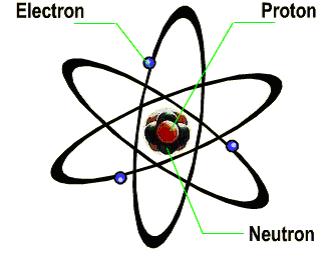
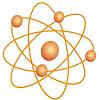 Nuclear Physics is a branch of Physics that studies the structures, properties and interactions of atomic nuclei. Atoms are the tiny particles of which all the substances in the world are composed. The structure of an atom is just like our solar system: in the center, there is a “sun” named as “nucleus”, which occupies most of the system’s mass; there are some “planets” called “electrons”, orbiting round the center. Nuclear Physics is basically a subject focusing on the research of the nucleus, and developing the possible applications in our society.
Structure of atoms
A nucleus is generally composed of two kinds of particles: protons and neutrons, except for hydrogen nucleus, which only contains a proton. Protons carry positive charges while neutrons are neutral. Electrons are negatively charged and the number of electrons is usually equal to that of protons. Thus, an atom is usually neutral as a whole. Protons and neutrons have similar masses, but electrons have a much smaller masses. Therefore, when we talk about the mass of an atom, the masses of the electrons inside are often neglected.
Origin of radioactivity
Most of the nuclei are stable, due to the strong force bonding the protons and neutrons together. However, some nuclei, usually large nuclei like Uranium-235, are unstable. In order to return to their stable state, they may go through a process called “decay”, which may give out particles or electromagnetic waves as by-products. We say these unstable nuclei are radioactive and they are named as radionuclides. The particles and electromagnetic waves released are called radiation.
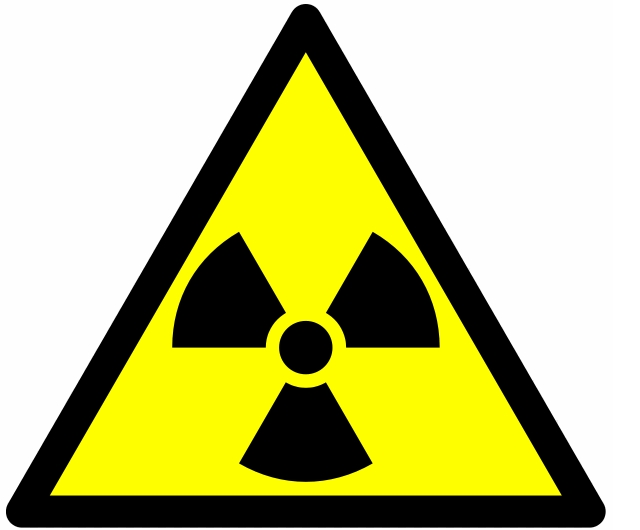
Most of the nuclei are stable, due to the strong force bonding the protons and neutrons together. However, some nuclei, usually large nuclei like Uranium-235, are unstable. In order to return to their stable state, they may go through a process called “decay”, which may give out particles or electromagnetic waves as by-products. We say these unstable nuclei are radioactive and they are named as radionuclides. The particles and electromagnetic waves released are called radiation.
 Non-ionizing radiation is the electromagnetic wave with relatively low energy level. It can only cause the molecules to vibrate and induces heating effects. Non-ionizing radiation includes ultraviolet, visible light, infrared, microwave as well as radio wave.
Ionizing radiation is high energy radiation which is able to remove electrons from atoms, resulting in the formation of ions. Ions carry positive charges and are readily for chemical reactions. Ionizing radiation is more dangerous in the sense that it can cause the breakdown of a substance. Ionizing radiation can be high speed particles like alpha particles, beta particles as well as neutrons; or high energy electromagnetic waves like gamma rays and x-rays.
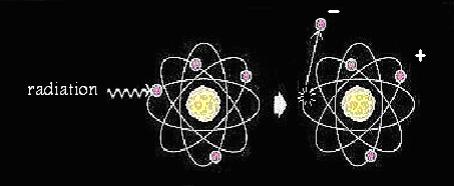
↑ An atom is being ionized.
Alpha particles (α-particles)
α-particles are particles consisting of two protons and two neutrons, which are identical to Helium-4 nuclei. They are generally emitted by heavy atoms, i.e. atoms having atomic numbers greater than 82, through a process called “alpha decay”. They have relatively large masses, low velocities and with +2 charges. These make them very likely to interact with other atoms and lose their energy quickly. As a result, the ionizing power of α-particles is very strong, but their penetrating power is the weakest among all types of ionizing radiation. α-particles can be stopped easily by a cardboard.
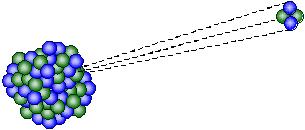
↑ α-decay
Beta particles (β-particles)
In general, β-particles refer to high speed electrons. They are emitted through “beta decay” of some radioactive nuclei. They carry -1 charges and are affected by an electromagnetic field. Their ionizing power is weaker than that of α-particles. Since they have much smaller masses and higher velocities than α-particles, β-particles have a greater penetrating power. A sheet of aluminium a few millimeters thick is enough to stop them.
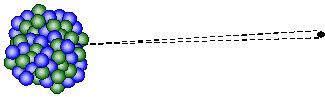
↑ β-decay
Gamma rays (γ-rays)
γ-rays are a type of high energy electromagnetic waves. They are generated by the transitions within radioactive nuclei, which is also known as “gamma decay”. γ-rays have no mass and no electrical charge. They are not affected by an electromagnetic field. γ-rays have the highest frequency, the shortest wavelength, and thus, the highest energy within the electromagnetic spectrum. Although their ionizing power is weak, they have great penetrating power and can pass through human body. Serious damages can be caused when they pass through living cells. γ-rays cannot be stopped completely, but thick barriers of lead or concrete can effectively diminish them.
X-rays
X-rays are also a type of high energy electromagnetic waves, just like γ-rays. In fact, the properties of the two types of rays are quite similar. The only difference is their origins. Unlike γ-rays, x-rays are emitted from the electron cloud as a result of electron excitation.
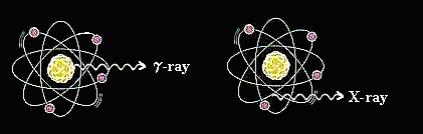
↑ A comparison between the origins of γ-rays and X-ray.
Neutrons
Neutrons are constituents of the atomic nucleus. They carry no charge and have a mass which is a little bit higher than that of protons. Neutron radiation is a kind of ionizing radiation which consists of free neutrons. They can be produced by nuclear fission or fusion processes. Although they are neutral, their ionizing power is still strong. Fast-moving neutrons are very penetrating and can only be stopped by hydrogen-rich materials, such as water or paraffin. In nuclear reactors, water is commonly used to moderate and control the speed of neutrons.
“Fusion” means “joining up”, while “fission” means “splitting”. Nuclear fusion and nuclear fission are two different types of nuclear activities which both release large amount of energy.
Nuclear fusion is a process which smaller nuclei join together to form larger ones. Usually, small atoms like hydrogen and helium undergo this process. In this way, energy is given out and the atoms would become more stable. Our Sun is giving out large amount of light and heat seconds by seconds through this process.
Nuclear fission is a process which heavy nuclei are split into parts. For atoms having atomic number greater than 82, their nuclei are unstable and are spontaneously decaying to form more stable nuclei. The total number of the unstable nuclei is continually decreasing; radiation, neutrons and lighter nuclei are then given out. For a fixed amount of unstable nuclei, say, Carbon-14, scientists discovered that its total amount is deducted by half for every 5730 years, so 5730 years was said to be the “half-life” of Carbon-14.
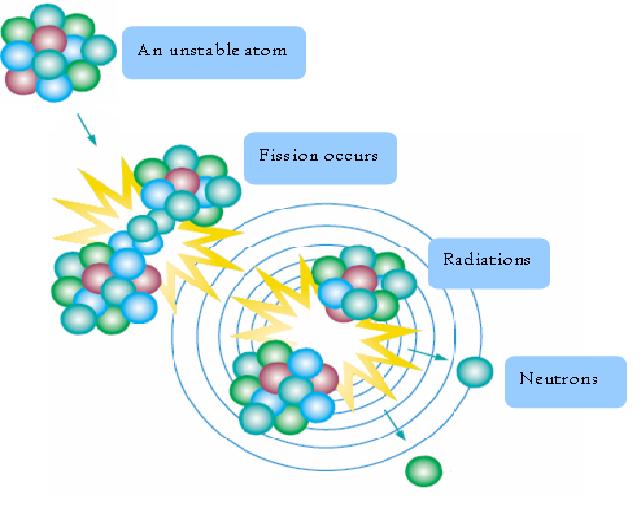
Besides, nuclear fission can also be triggered as well. Some atoms like Uranium-235 are highly unstable. When one of these atoms is hit by an incoming neutron, the atom will be split apart, heat and 2 to 3 neutrons are released. The neutrons released will then split the nuclei of the neighbouring atoms. The spitting continues and this is called a “chain reaction”. In this way, a lot of heat can be accumulated at a very short time.
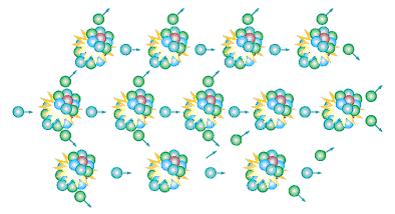
↑ Chain reaction
One point to note, for atoms having atomic number smaller than 82, they cannot undergo nuclear fission; they can only carry out nuclear fusion.
As mentioned in the previous section, nuclear activities come along with large amount of energy. The biggest challenge is how we can capture the energy effectively and safely.
Nowadays, nuclear energy is generally regarded as using heat produced by the chain reaction of Uranium-235 to produce electricity. There are many types of nuclear reactors making use of different principles to generate electricity. One common type is the Pressurised Water Reactor (PWR). The basic working principle is that the heat produced by nuclear fission is first carried away by pressurised water to the steam generator. Water from another circuit is boiled by the heat and the steam formed is then used to drive a turbine-generator to produce electricity. Water in the primary circuit is pressurised to raise its boiling point, so that heat can be carried more efficiently.
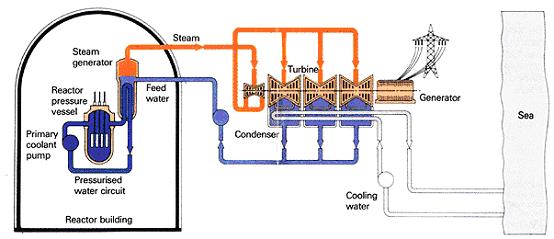
↑ A Pressurised Water Reactor
The fuel (Uranium-235) undergoes the chain reaction inside the reactor pressure vessel. Besides the fuel rods, there are some more rods called “control rods”, and the whole vessel is filled with a “moderator”.
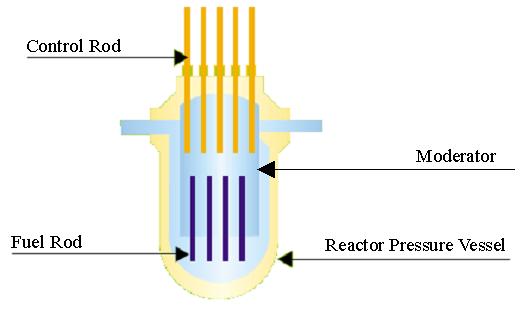
The high energy neutrons released by fission, fast neutrons, travel at very high speeds. To raise the efficiency of the reactor, the fast neutrons must be slowed down to increase its probability of hitting more uranium atoms and thus inducing more fission. Commercial type nuclear reactors normally use a moderator to slow down the high energy neutrons to low energy neutrons, which are named as thermal neutrons. Ordinary water, graphite and the more expensive heavy water are some examples of moderators used in various types of nuclear reactors.
If the chain reaction is going too fast, the large amount of heat accumulated can cause explosions, so control measures are needed to prevent dangers. In case of emergency, in order to slow down or even stop the chain reaction, control rods can be inserted into the vessel. The materials (typical examples include boron and cadmium) in the control rods can absorb neutrons, and thus stop them from continuing the chain reaction.
Apart from the Pressurised Water Reactor, there are other types of commercial nuclear reactors, including Boiling Water Reactor (BWR), Pressurised Heavy Water Reactor (CANDU), Graphite Moderated, Direct Cycle (Boiling Water) Pressure Tube Reactor (RBMK), etc.
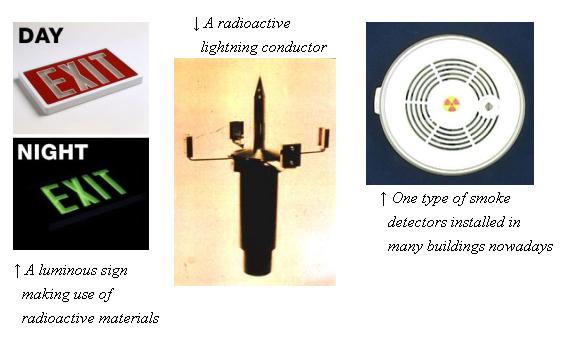
The applications of radiation are becoming more and more extensive in our daily lives. In medical use, radiations can provide images for identifying abnormal changes in body organs and tissues; they can also be used in therapy treatments, such as destroying cancer cells. In industrial applications, radiations are used to image defects in welds and metal castings; they are also used in automatic quality control systems in production lines, such as to gauge fluid level in beverage cans, and to measure the thickness of electroplates. Radiations can also be used in archaeological (for dating the antiquities), agricultural (for sterilizing pest and fertilizer tracers), making consumer products like smoke detectors, luminous signs, radioactive lightning conductors, etc.
“Understanding Radiation”, Hong Kong Observatory
http://www.hko.gov.hk/education/dbcp/radiation/eng/r1.htm
“Nuclear Physics”, University of Winnipeg
http://theory.uwinnipeg.ca/physics/nucl/
“HyperPhysics”, Georgia State University
http://hyperphysics.phy-astr.gsu.edu/hbase/nuccon.html
“How do you know about Nuclear Power?”, Hong Kong Nuclear Investment Company Limited (HKNIC)
http://www.hknuclear.com/nflash/eng/html/CLP_Nuclear.pdf
“About Guangdong Daya Bay Nuclear Power Station”, HKNIC
http://www.hknuclear.com/nflash/eng/html/gnips.htm
“Nuclear Power for Electricity Generation”, Hong Kong Observatory
http://www.hko.gov.hk/education/dbcp/pow_stat/eng/r1.htm
“Power production: Nuclear Power”, Physics World