


Competence Standards
1. Up to August 2028 – Current / existing competence standards
(Current / existing competence standards — applicants may continue to use these until August 2028. Between September 2026 and August 2028 applicants may choose either the current or the revised standards.)
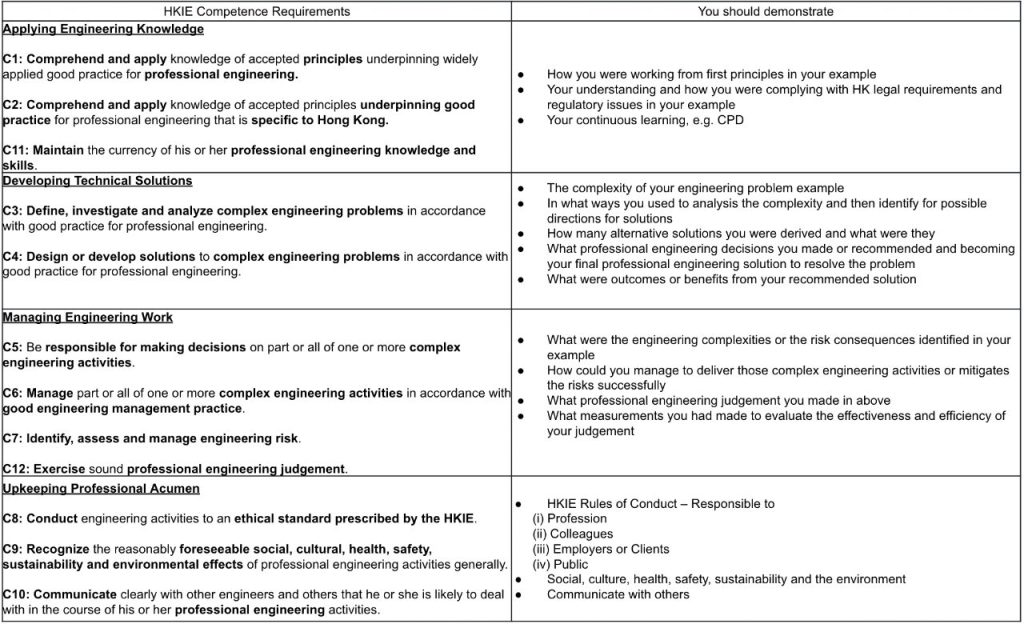
Applying Engineering Knowledge
C1: Comprehend and apply knowledge of accepted principles underpinning widely applied good practice for professional engineering.
C2: Comprehend and apply knowledge of accepted principles underpinning good practice for professional engineering that is specific to Hong Kong.
C11: Maintain the currency of his or her professional engineering knowledge and skills.
Developing Technical Solutions
C3: Define, investigate and analyze complex engineering problems in accordance with good practice for professional engineering.
C4: Design or develop solutions to complex engineering problems in accordance with good practice for professional engineering.
Managing Engineering Work
C5: Be responsible for making decisions on part or all of one or more complex engineering activities.
C6: Manage part or all of one or more complex engineering activities in accordance with good engineering management practice.
C7: Identify, assess and manage engineering risk.
C12: Exercise sound professional engineering judgement.
Upkeeping Professional Acumen
C8: Conduct engineering activities to an ethical standard prescribed by the HKIE.
C9: Recognize the reasonably foreseeable social, cultural, health, safety, sustainability and environmental effects of professional engineering activities generally.
C10: Communicate clearly with other engineers and others that he or she is likely to deal with in the course of his or her professional engineering activities.
2. September 2028 onwards – Revised HKIE Competence Standards
(Full implementation of the Revised HKIE Competence Standards for Corporate Membership)
Area I: Applying Engineering Knowledge
Comprehend and apply knowledge of accepted principles underpinning widely applied good practice for professional engineering, including those specific to Hong Kong, as well as maintain currency of professional engineering knowledge, skills and emerging technologies :
(a) understand and grasp appropriate engineering knowledge, read, understand, evaluate literature and put into practice new knowledge, and seek advice, where necessary, to supplement own knowledge and experience
(b) demonstrate awareness of and address appropriately the Discipline-specific engineering requirements as well as the related legal requirements and regulatory issues in Hong Kong
(c) work from first principles to make reliable predictions of outcomes
(d) demonstrate a commitment to extending and developing knowledge and skills by participating in education, training, mentoring or other programmes contributing to his/her professional development and engaging in collaborative activities with professional engineers
Area II: Developing Technical Solutions
Define, investigate, analyse and solve complex engineering problems in accordance with good practice for professional engineering, exercise sound professional engineering judgement among competing requirements and be responsible for making decisions on the activities
(a) identify and understand the scope of the problem
(b) look into relevant details, information and data using appropriate information technologies and quantitative and qualitative techniques where applicable
(c) verify the correctness of results and conduct any necessary research and reach substantiated conclusions
(d) identify needs, requirements, constraints and performance criteria that may be competing and demanding in nature
(e) formulate concepts and design or develop possible solutions based on engineering principles and with consideration of different perspectives and engagement of stakeholders
(f) demonstrate the ability to identify alternative options, choose between options and justify such decisions
(g) evaluate the pros and cons of the possible solutions and select a solution that best satisfies needs, requirements and criteria
(h) be recognised by peers for his/her ability to exercise sound professional engineering judgement
(i) plan and implement effective, efficient and practical systems or solutions
(j) evaluate outcomes against original criteria and assumptions
Area III: Managing Engineering Work
Manage part or all of one or more complex engineering activities in accordance with good engineering management practice including risk management, sustainability considerations and cultural requirements, and be responsible for making such decisions
(a) plan, schedule and organise engineering projects to deliver specified outcomes, and demonstrate awareness of financial considerations in managing the projects
(b) manage resources, including personnel, finance and physical resources in engineering projects
(c) develop corresponding management policies, procedures and protocols to manage risks, identify hazards, and formulate risk profile in design and operations
(d) manage conflicting demands and expectations and apply appropriate quality assurance techniques to manage engineering projects
(e) act appropriately, make decisions and take responsibility during the course and/or for the outcome of complex engineering activities undertaken
Area IV: Contributing to Sustainability
Recognise the reasonably foreseeable economic, social, cultural, health, safety, sustainability and environmental effects of professional engineering activities generally
(a) consider and take into account of the impact and long-term effects of engineering activities on the economy, society, culture, health, safety, sustainability and environment with reference to the 17 UN SDGs
(b) project the outcome of professional engineering activities in the context of economic, social, cultural, health, safety, sustainability and environmental aspects
Area V: Upkeeping Professional Acumen
Conduct engineering activities to an ethical standard and communicate and collaborate clearly and inclusively with other engineers and stakeholders that he or she is likely to deal with in the course of his or her professional engineering activities
(a) demonstrate understanding of the HKIE Rules of Conduct and behave accordingly in difficult circumstances (including demonstrating an awareness of limits of capability; acting with integrity and honesty and demonstrating self management)
(b) use oral and written communication to convey clear message through a range of media suitable to the context that meet the needs and expectations of the audience
(c) treat people with respect and develop empathy and use active listening skills when communicating with others
(d) operate effectively as a team member
——————————————————————————————————————————————————————————————————————————————————————
Complex Engineering Activities
“Complex engineering activities” mean engineering activities or projects that have some or all of the following characteristics:
involve the use of diverse resources including people, money, equipment, materials and technologies
require resolution of critical problems arising from interactions between wide-ranging technical, engineering and other issues
have significant consequences in a range of contexts
involve the use of new materials, techniques, or processes or the use of existing materials, techniques, or processes in innovative ways
“Complex engineering problems” have some or all of the following characteristics
involve wide-ranging or conflicting technical, engineering, and other issues
have no obvious solution and require originality in analysis
involve infrequently encountered issues
are problems beyond the scope of standards and codes of practice for professional engineering
involve diverse groups of stakeholders with widely varying needs
have significant consequences in a range of contexts
cannot be resolved without in-depth engineering knowledge