
(香港,2022年6月11日) 香港工程師學會 (下稱「學會」) 於今天舉行頒獎典禮暨迎新會,表揚「香港工程師學會創意獎2022」參賽者的創新思維。
學會每年均舉辦「香港工程師學會創意獎」,鼓勵會員發揮創新思維,並對他們在工程界及社會有貢獻的理念及應用予以肯定。「香港工程師學會創意獎」前身為「香港工程師學會青年會員創意獎」,共分兩個組別 —「香港工程師學會創意獎」及「香港工程師學會創意獎 (青年會員組)」。自2020年起,前者供所有會員參加,後者則讓35歲或以下的會員參與。兩個組別下再分設組別I —發明,以及組別 II—創新應用。
會長鍾國輝工程師對於今年收到的優秀參賽作品表示欣喜,「今年的『香港工程師學會創意獎』的得獎作品別具創意,希望這些發明能廣被採用,在環保、建造、醫療和環境等不同範疇作出貢獻。」
香港工程師學會創意獎2022
組別I —發明 | 馮憲平教授、工程師 獲獎作品:直接熱充電電池轉化廢熱為電能 |
|---|---|
組別II — 創新應用 | 何冠豪工程師、馮偉堅工程師、黃振才工程師及 獲獎作品:轉體式建橋法 |
香港工程師學會創意獎(青年會員組)2022
組別I —發明 | 周柏康先生及吳展鴻先生 獲獎作品:為香港醫療系統開發智能鍋爐清潔及檢測機械人 |
|---|---|
組別II — 創新應用 | 梁婉婷女士 獲獎作品:小鐵牛 – 遙控清潔濕井水底機器車 |
香港工程師學會創意獎2022獲獎作品簡介
組別I —發明
得獎者:馮憲平教授、工程師
獲獎作品:直接熱充電電池轉化廢熱為電能
低溫廢熱存在於環境、初級能源轉化以至人體之中,但現時轉化低溫廢熱的技術一般面對成本高昂、複雜或效率太低等問題。馮憲平教授、工程師領導的團隊,研發了「直接熱充電電池」,能把低溫廢熱轉化為電力。
「直接熱充電電池」的原理是使用不對稱電極,以氧化石墨烯/鉑金納米顆粒為陰極,聚苯胺為陽極,在鐵二價離子與鐵三價離子的電解液中恆溫加熱,電池可自行充電及發電。電池單一元件的熱電轉換效率超過3.5%,即有效把3.5%的廢熱轉化成電能,較現時技術的少於1%顯著提高,每個元件體積約為1.5平方厘米,厚度僅1至1.5毫米,體積輕薄、成本廉宜、技術簡單,而且電池可以撓曲,為熱電轉化電池帶來根本性的改變。
馮教授、工程師相信,低溫廢熱是一種被忽視的可再生能源,隨著技術的突破,有助提升能源效益以及減少碳排放,對社會及經濟帶來莫大益處。
馮教授、工程師現時為香港城市大學先進設計與系統工程系教授。加入學術界前,曾於台灣積體電路製造公司和健鼎科技任職。通過成立初創公司,此發明正從學術研究向實際應用邁進。
組別II — 創新應用
得獎者:何冠豪工程師、馮偉堅工程師、黃振才工程師及郭紹延工程師
獲獎作品:轉體式建橋法
香港城市發展密度高,要在已發展的城市地區興建新的基礎設施,有時面臨不少挑戰。何冠豪工程師、馮偉堅工程師、黃振才工程師及郭紹延工程師的團隊,首度在港應用轉體式建橋法,在元朗Yoho Hub建造一條行車及一條行人天橋。
相關天橋座落於輕鐵電纜上方,周圍被主要交通幹道圍繞,連接位置亦十分接近元朗西鐵站的路軌,這些限制均增添工程難度。團隊參考街市常用的「秤」,兩座鋼結構橋樑均在南面地盤樓頂位置裝嵌建造,借助重達1,300噸的鋼坯作為「秤砣」,橋樑圍繞轉盤旋轉180度,直接越過輕軌鐵路及交通主幹道,最終分別下降到元朗站和北面站台,並使用新物料,降低轉動時所產生的摩擦阻力。
團隊僅用了四個午夜,便完成兩座天橋橫跨輕鐵路軌部分的工程。這種嶄新的橋樑施工方法,把對鐵路營運和道路使用者造成的干擾大幅降低,並使建築工人能夠在較低的高度進行所有鋼結構的裝嵌,提高施工安全。
本年度,學會亦同時頒發優異獎予參與組別I的王予紅工程師(獲獎作品:瀝青材料的微觀結構及其對瀝青工程特性影響的突破性研究進展)。
香港工程師學會創意獎 (青年會員組) 2022獲獎作品簡介
組別I —發明
得獎者:周柏康先生及吳展鴻先生
獲獎作品:為香港醫療系統開發智能鍋爐清潔及檢測機械人
新型冠狀病毒疫情當前,保護工作人員和病人免受傳染病的感染至關重要。周柏康先生及吳展鴻先生的團隊研發「智能鍋爐清潔及檢測機械人」,結合了人工智能、電腦視覺與模式識別技術,整個智能系統提高了鍋爐效率和可用性,以滿足醫院的供暖、洗衣和消毒需求。
疫情期間,工作人員不分晝夜以鍋爐高溫消毒手術器具、衣物等,以維持正常運作。工作人員需定期維修、保養、清潔及檢討運作流程,令醫院使用鍋爐消毒更具效率,但疫情導致住院病人急增、人手緊張,加上工作環境高溫潮濕,有時更需高空工作,同時工作具備一定重複性、勞工密集,衍生出以機械人取代人手的需求。此系統能減輕人手工作,並有效地識別與管道缺陷有關的圖像資訊,以便作出預測性維護。團隊曾實地考察,並向前線工作人員了解實質運作流程,確保機械人能滿足營運需要。
周先生及吳先生現職於機電工程署衞生工程部,與香港科技園公司創業培育計劃的初創企業合作研發此項發明,系統的設計已獲專利保護,除醫療行業外,亦可應用在酒店、食品和成衣工業。
組別II — 創新應用
得獎者:梁婉婷女士
獲獎作品:小鐵牛 – 遙控清潔濕井水底機器車
污水處理是城市可持續發展的重要一環。梁婉婷女士應用了聲納影像及定位技術,研發了命名為「小鐵牛」的遙控清潔濕井水底機器車,以取代現行以工作人員進入污水濕井進行清淤的密閉空間工作。
污水處理廠內的濕井是住宅、商業和工業污水的第一個接收點,日積月累之下,井底累積不同類型的沉積物,有時甚至已經硬化,難於清理。傳統的清淤工作,須由具備核准工人資格的工作人員進入濕井內進行。濕井屬於密閉空間,在內工作會有一定的安全風險,加上清淤工作只可於污水流量較低的時段進行,因此清淤效率低且成本高昂,若不處理沉積物,會對下游泵水系統的機件造成損耗,增加維修成本及降低泵水系統的效率。
梁女士檢視現時的運作模式,在渠務署灣仔東基本污水處理廠一個濕井實地試用機械人,證實能清理硬化的沉積物及監察井內環境,試用機械人後,灣仔東基本污水處理廠的維修時間亦明顯減少。此項創新發明不但能提高污水處理廠的運作效率及節省維修成本,更大大提升了有關工作的職業健康和安全水平。
梁女士現時任職渠務署機電工程師,期望可將該項發明進一步推展至其他類似環境的渠務署設施及水下工程中使用。
學會亦同時頒發優異獎予組別I的梁子超先生(獲獎作品:衛星一號:除泡機械人),以及組別II的葉讚鋒先生及洪信謙先生的團隊(獲獎作品:非接觸式震動測量方案於發電廠設備的應用)。
創新思維是推動社會進步的力量,學會期望各得獎者可運用創科力量,持續為香港的發展作出貢獻。
如欲垂詢,請與香港工程師學會傳訊統籌部聯絡。
電話:2895 4446
傳真:2882 6825
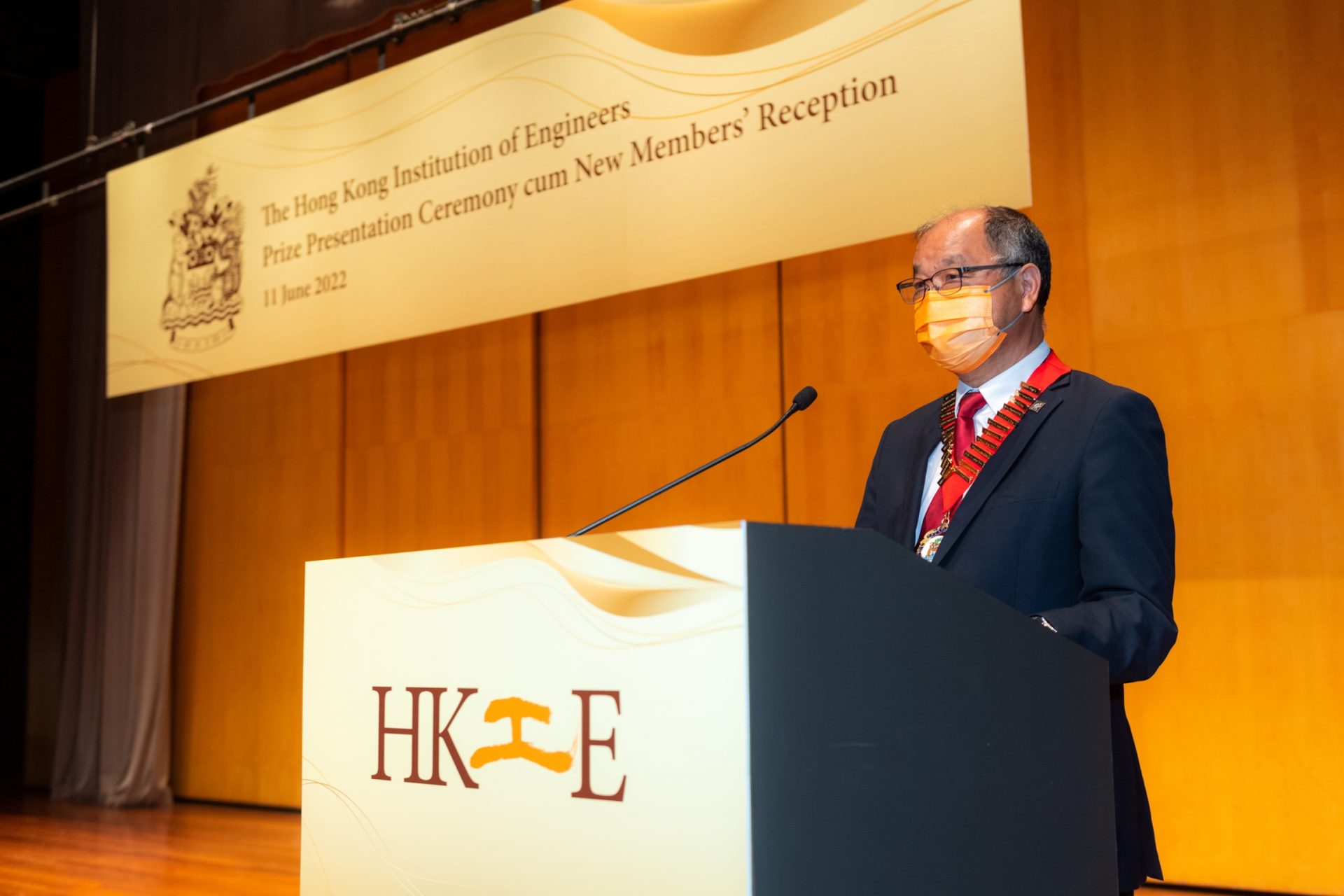
會長鍾國輝工程師致辭
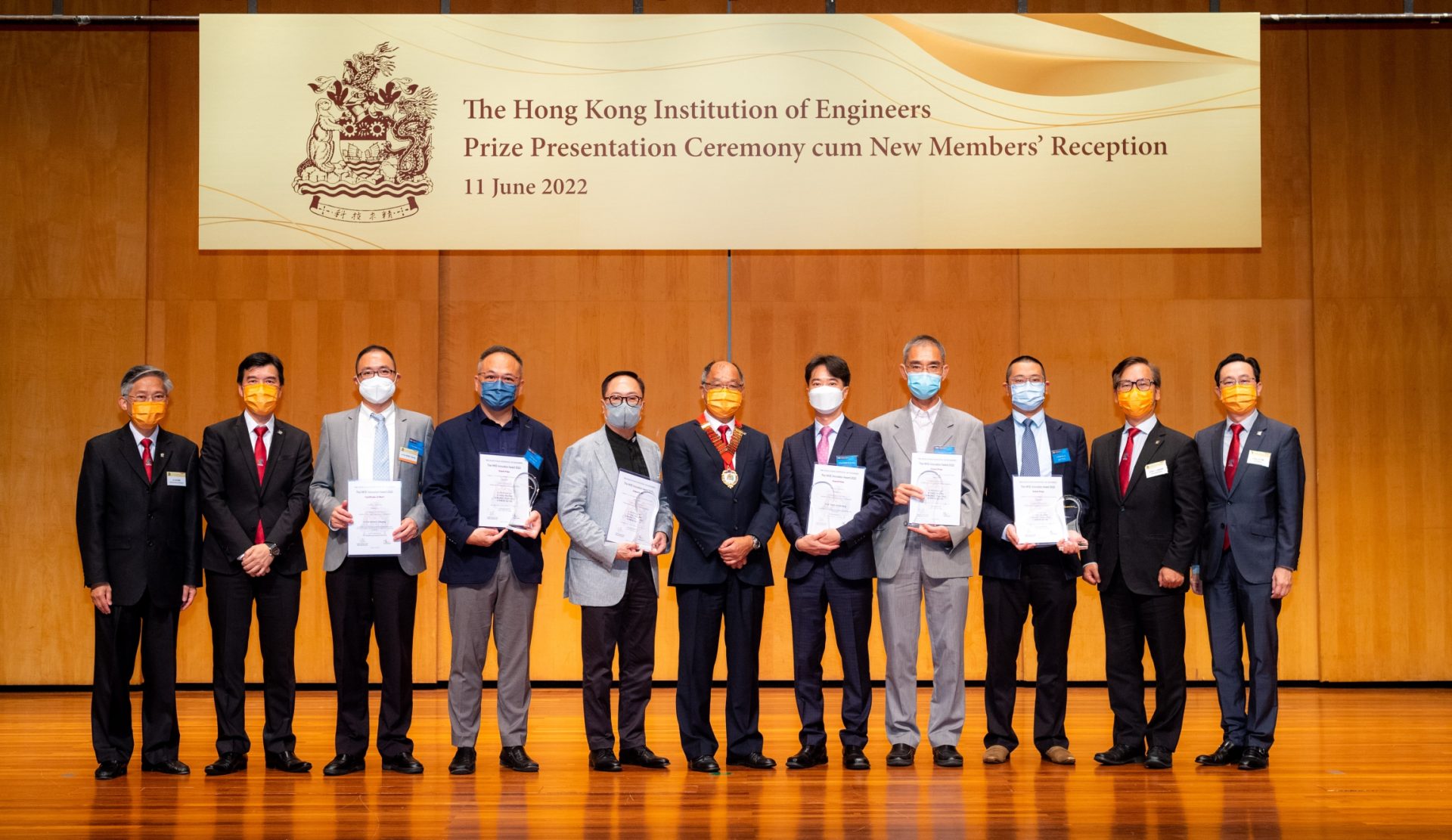
會長鍾國輝工程師(中),高級副會長卜國明工程師(右二),副會長李志康博士、工程師(左二),副會長馬紹祥工程師 (右一),秘書長韓志強工程師(左一)與香港工程師學會創意獎2022得獎者合照,包括:
組別I —發明得獎者馮憲平教授、工程師 (右五),組別II —創新應用得獎者何冠豪工程師 (左四)、馮偉堅工程師(左五)、黃振才工程師(右四)及郭紹延工程師(右三),以及組別I —發明優異獎得獎者王予紅工程師(左三)
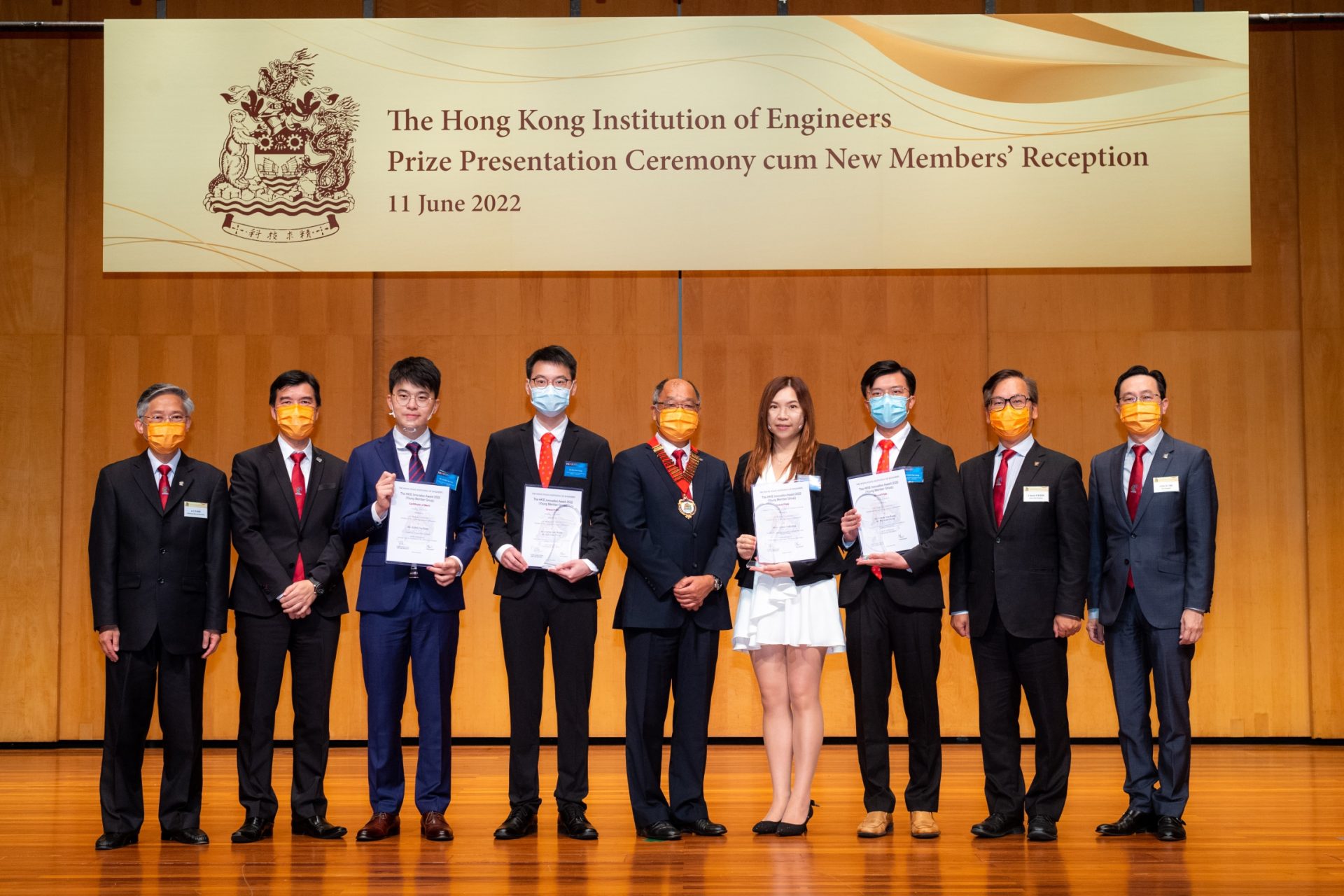
會長鍾國輝工程師(中),高級副會長卜國明工程師(右二),副會長李志康博士、工程師(左二),副會長馬紹祥工程師 (右一),秘書長韓志強工程師(左一)與香港工程師學會創意獎 (青年會員組) 2022得獎者合照,包括:
組別I —發明得獎者周柏康先生(右三)、吳展鴻先生(左四),組別II —創新應用得獎者梁婉婷女士(右四) ,組別I —發明優異獎得獎者梁子超先生(左三)
(11 June 2022, Hong Kong) The Hong Kong Institution of Engineers (HKIE) Prize Presentation Ceremony cum New Members’Reception was held today, recognising members’ innovative ideas and applications in The HKIE Innovation Award 2022.
The HKIE Innovation Award 2022 is open for all members of the HKIE to encourage creativity and innovation in engineering among members, with a vision to recognise pioneering ideas and applications that would benefit the engineering industry and the world we are living in.
The Award is divided into two Group, “The HKIE Innovation Award” for members of all ages, and “The HKIE Innovation Award (Young Member Group)” open to members aged 35 or below. Entrants can focus on any engineering discipline within the context of the HKIE. There are two main categories: Category I – An Invention, and Category II – An Innovative Application of Engineering Theories. The innovativeness of the design is assessed on its originality and creativity.
President Ir Edwin Chung expressed his gratification at the innovations presented to the panel, “The winning entries are full of potential for implementation and application. I wish the winners success in bringing benefits to environment protection, construction, medical aspects and beyond.”
The HKIE Innovation Awards 2022
Category I – An Invention | Ir Prof Feng Shien Ping Awarded Project: Direct Thermal Charging Cell for Waste Heat to Electricity Conversion |
|---|---|
Category II – An Innovative Application of Engineering Theories | Ir Ho Koon Ho, Ir Fung Wai Kin, Ir Wong Chun Choi and Ir Kwok Siu Yin Awarded Project: Rotational Bridge Launching Method at “The Yoho Hub” |
The HKIE Innovation Awards (Young Member Group) 2022
Category I – An Invention | Mr Chow Pak Hong and Mr Ng Chin Hung Awarded Project: Smart Boiler Cleaning & Inspection Robot for Healthcare System in Hong Kong |
|---|---|
Category II – An Innovative Application of Engineering Theories | Ms Leung Yuen Ting Awarded Project: The Mini Bull – Remotely Operated Underwater Wet Walls Cleaning Vehicle |
Awarded Projects of The HKIE Innovation Awards 2022
Category I – An Invention
Awardee: Ir Prof Feng Shien Ping
Submission: Direct Thermal Charging Cell for Waste Heat to Electricity Conversion
Waste heat is abundantly available in the environment, conversion of primary energy and even in human body. Existing technology to convert low-grade heat to electricity is expensive, complicated or low in efficiency. The team led by Ir Prof Feng Shien Ping invented the Direct Thermal Charging Cell, which may be the key to unlock the potential of heat-to-electricity conversion.
This new electrochemical system uses asymmetric electrodes of graphene oxide (GO)/Pt nanoparticles cathode and polyaniline anode in aqueous Fe2+/Fe3+ redox electrolyte for the efficient conversion of low-grade heat to electricity, which is self-regenerated. The cell has a heat-to-electricity efficiency of 3.5%, surpassing the 1% of existing technology in low grade heat regime. Each basic unit sized only 1.5 cm2 and thickness 1 to 1.5 mm and it is low cost, bendable and technically simple, bringing a fundamental change to the heat-to-electricity conversion.
Ir Prof Feng believes low-grade heat is a source of renewable energy that being overlooked. It will be a promising opportunity to hike up energy efficiency and cut carbon emission, which will bring tangible economic and environmental benefits to the society.
Ir Prof Feng is a Professor of Advanced Design and Systems Engineering at City University of Hong Kong. Before entering academia, he was working at Taiwan Semiconductor Manufacturing Company and Tripod Technology Corporation. By establishing startup company and collaborating with industries, the invention is moving from academic research toward real applications.
Category II – An Innovative Application of Engineering Theories
Awardees: Ir Ho Koon Ho, Ir Fung Wai Kin, Ir Wong Chun Choi and Ir Kwok Siu Yin
Submission: Rotational Bridge Launching Method at “The Yoho Hub”
Hong Kong has a high intensity of urban development. Engineers often face challenge to develop new infrastructure with urban area. The team of Ir Ho Koon Ho, Ir Fung Wai Kin, Ir Wong Chun Choi and Ir Kwok Siu Yin launched a footbridge and a vehicular bridge with the rotational bridge launching method, which is the first project in Hong Kong using such method.
The two bridges located on top of existing Yuen Long Light Rail railway tracks and several major trunk roads at Yuen Long with extremely high traffic volume. It is close to the West Rail Yuen Long Station which makes the construction more complicated. Inspired by the old market “scales”, with aid of the 1300-ton steel billets acting as counterweight (秤砣), the bridges were rotated 180° about a turntable directly over the Light Rail and trunk road, and finally lowered onto Yuen Long Station and the Northern podium respectively. A new material was used to tremendously reduce the frictional resistance.
In just 4 midnights, the team completed the constructions of two bridges across the Light Rail. This innovative bridge construction method kept the risks of disturbances to the railway operations and road users in the smallest possible way, and also enabled the workers to perform all steel erections at a much lower elevation.
Besides, the Award of Merit of Category I went to Ir Prof Wang Yuhong (Submission: A breakthrough in discovering the fundamental structure of bitumen and determining its impacts on bitumen’s engineering properties).
Awarded Projects of The HKIE Innovation Awards (Young Member Group) 2022
Category I – An Invention
Awardees: Mr Chow Pak Hong and Mr Ng Chin Hung
Submission: Smart Boiler Cleaning & Inspection Robot for Healthcare System in Hong Kong
Protecting the well-being of hospital staff and patients against contracting infectious diseases in hospitals is critical in the current COVID-19 episode. Mr Chow Pak Hong and Mr Ng Chin Hung have developed the Smart Boiler Cleaning and Inspection Robot, integrating artificial intelligence with computer vision and pattern recognition. This invention helps maximise boiler plant efficiency and availability to meet heating, laundry and sterilisation needs of the hospital.
During COVID-19 pandemic, the steam boiler system operated around the clock to sterilise surgical tools and healthcare linen to maintain the normal operation of hospitals. Staff need to carry out regular maintenance of fire tubes, cleaning and flaws inspection to enhance efficiency. However, the pandemic leads to the shortage of manpower and surge of inpatients, with the nature of working at height and a relative hot humid working environment, repetitive work pattern and labour intensive, developing the needs of using robots to replace manpower. The System reduces manual effort and effectively discerns useful graphs related to flaws on tube to achieve predictive maintenance. The team investigated the site constraints and maintenance workflow to ensure the robot can meet the operational needs.
Mr Chow and Mr Ng currently work at the Health Sector Division of the EMSD, whom collaborated with a technology startup of Hong Kong Science and Technology Parks’Incubation Programme for this invention. Other than medical sector, it can also be adopted in hotel, food and garment industry. The design of the system has already obtained patent protection.
Category II – An Innovative Application of Engineering Theories
Awardee: Ms Leung Yuen Ting
Submission: The Mini Bull – Remotely Operated Underwater Wet Wells Cleaning Vehicle
Sewage treatment plays a vital role in sustainable urban development. Ms Leung Yuen Ting developed a remotely operated underwater wet wells cleaning vehicle named the ‘Mini Bull’. Overcoming challenges in the corrosive and almost invisible sewage environment, it can replace certified workers to perform confined space cleaning works in wet wells.
Residential, commercial and industrial sewages are first collected at the wet well of sewage treatment plants. Due to the nature of its application, the bottom of the wet well is often accumulated with sediments which would in turn adversely affect the downstream pumping systems. Wet well cleaning is therefore an essential maintenance work in sewage treatment. Conventionally, wet well cleaning is carried out by certified workers in confined spaces and under low sewage flow condition. These conditions make the cleaning works extremely dangerous, costly and inefficient. Without effective wet well cleaning, the sediment accumulation at the bottom would adversely affect downstream pumping systems, increase corrective maintenance cost and decrease pumping system availability.
Ms Leung reviewed existing maintenance practice and carried out on-site trials at the wet well of Wan Chai East Preliminary Treatment Works (PTW). It is proven that the Mini Bull can overcome the invisible environment under sewage to perform cleaning of hardened sediments and condition monitoring in wet wells. An over one-month man-entry cleaning works at a wet well could be shortened to complete within one day and with a lower cost. It also greatly reduces the need for pump maintenance in the PTW. This invention not only enhances operational efficiency and saves maintenance costs, but also considerably improves the occupational health and safety level of underwater works.
Ms Leung is now working as an Electrical and Mechanical Engineer in Drainage Services Department and the invention would be applied at other similar sewage treatment facilities and underwater works with similar conditions.
Besides, the Award of Merit (Category I) went to Mr Leung Tsz Chiu with his submission of Satellite No.1 – Foam Removal Robot, and the Award of Merit (Category II) went to Mr Ip Tsan Fung and Mr Hung Shun Him with the submission of Contactless Vibration Measurement Solution for Power Plant Equipment.
Innovation drives the development and progression of the society. The Institution hopes awardees can make good use of their power of innovation to contribute to Hong Kong’s future development.
For media enquiries, please contact:
The Hong Kong Institution of Engineers
Corporate Communications Section
Tel: 2895 4446
Fax: 2882 6825
Email: corpcom@hkie.org.hk
Ir Edwin K F Chung, President of the HKIE, delivering an address
Ir Edwin K F Chung, President of the HKIE (middle); Ir Aaron K M Bok, Senior Vice President of the HKIE (2nd right); Ir Dr Barry C H Lee, Vice President of the HKIE (2nd left); Ir Eric S C Ma, Vice President of the HKIE (1st right); Ir C K Hon, Chief Executive and Secretary of the HKIE (1st left); and awardees of The HKIE Innovation Awards 2022:
Ir Prof Feng Shien Ping, awardee of Category I – An Invention (5th right); Ir Ho Koon Ho (4th left), Ir Fung Wai Kin (5th left), Ir Wong Chun Choi (4th right) and Ir Kwok Siu Yin (3rd right), awardees of Category II – An Innovative Application of Engineering Theories; Ir Prof Wang Yuhong, Certificate of Merit of Category I – An Invention (3rd left)
Ir Edwin K F Chung, President of the HKIE (middle); Ir Aaron K M Bok, Senior Vice President of the HKIE (2nd right); Ir Dr Barry C H Lee, Vice President of the HKIE (2nd left); Ir Eric S C Ma, Vice President of the HKIE (1st right); Ir C K Hon, Chief Executive and Secretary of the HKIE (1st left); and awardees of The HKIE Innovation Awards (Young Member Group) 2022:
Mr Chow Pak Hong (3rd right) and Mr Ng Chin Hung (4th left), awardees of Category I – An Invention; Ms Leung Yuen Ting (4th right), awardee of Category II – An Innovative Application of Engineering Theories; Mr Leung Tsz Chiu (3rd left), Certificate of Merit of Category I – An Invention awardee